
The layout of a cannabis processing facility determines its compliance ceiling, its operational efficiency, and : ultimately : its profitability. A well-designed processing facility flows raw material through each stage with minimal contamination risk, logical personnel movement, and equipment positioned to maximize throughput per square foot. A poorly designed one creates daily friction, regulatory exposure, and retrofits that cost three times what they would have at the design stage.
Last updated: August 25, 2026. Technical review: Staged merge pending review by the project architect, MEP engineer, fire-code consultant, operations lead, and AHJ for the jurisdiction.
This guide covers the core principles of cannabis processing facility layout design: room sequencing, contamination control, equipment placement, airflow and HVAC zoning, regulatory compliance requirements, and the specific design decisions that separate high-performing facilities from ones that struggle to scale.
The Business Case for Getting Layout Right the First Time
Facility design errors are expensive in cannabis because the regulatory environment compounds them. A processing room that isn't properly separated from packaging creates cross-contamination risk that can trigger a recall. An HVAC system that shares air between extraction and infusion creates compliance exposure. Equipment placed for convenience rather than workflow creates labor inefficiency that compounds across thousands of production hours.
Urth & Fyre has designed and optimized over 1,000,000 square feet of cannabis cultivation and processing facilities. The pattern across our highest-performing client facilities is consistent: the operators who invested in proper layout design at the outset : not retrofitted it after a failed inspection or a margin squeeze : have significantly lower operating costs, higher compliance pass rates, and more scalable operations.
Core Layout Principles for Cannabis Processing Facilities
1. Unidirectional Flow
Cannabis processing facilities should be designed around unidirectional product flow : raw material enters, moves through each processing stage in sequence, and exits as finished packaged product without backtracking or crossing contaminated zones. This principle eliminates most cross-contamination risk and simplifies regulatory documentation, because product movement is predictable and auditable.
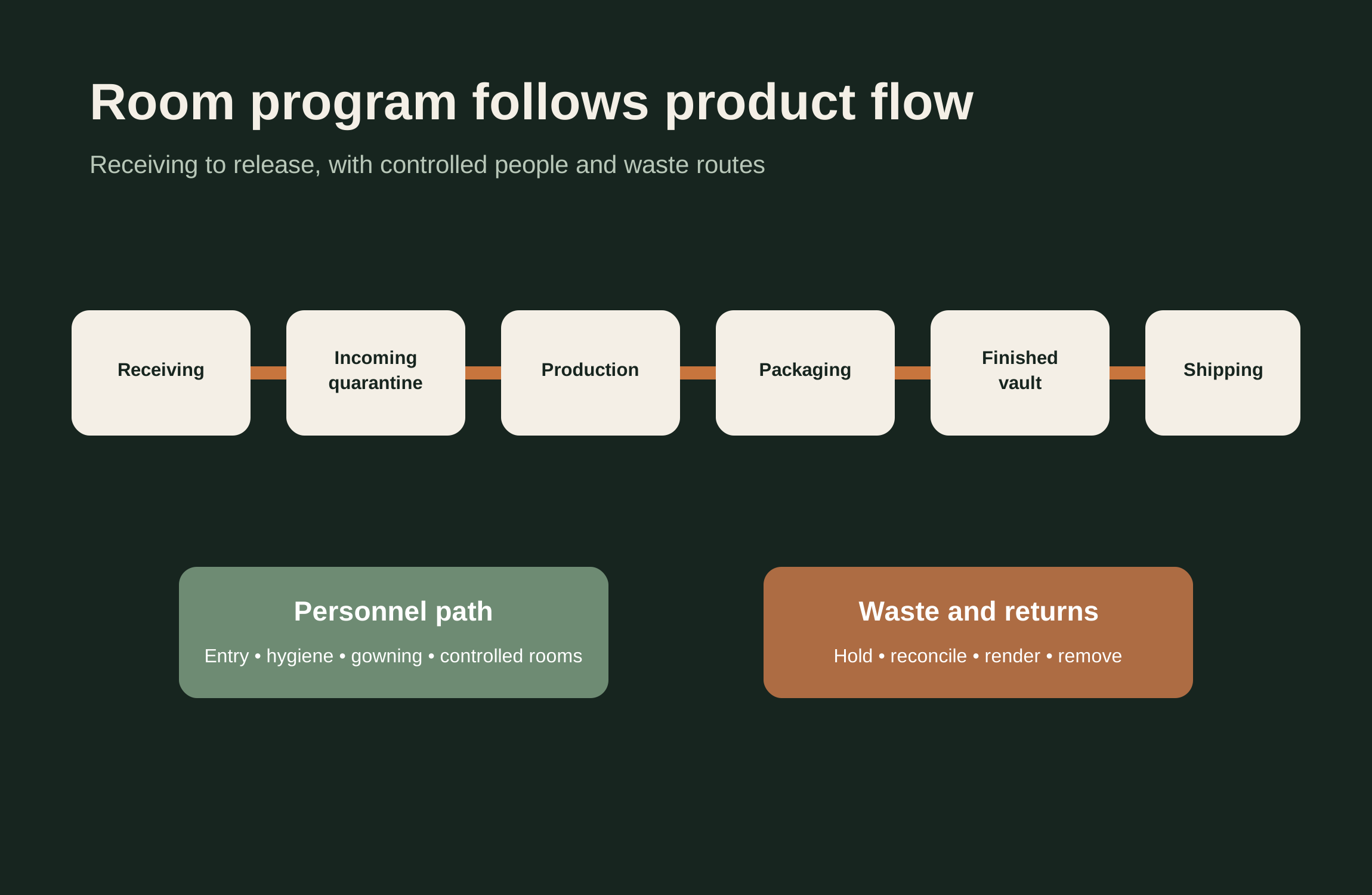
Map your product flow before designing room placement: intake and receiving → storage (raw material) → processing (extraction, distillation, infusion) → production (edibles, filling, forming) → QC hold → packaging → finished goods storage → shipping. Each room in your facility should correspond to a stage in this flow.
2. Contamination Control Zoning
Cannabis processing regulations in most states require physical separation between processing stages with different contamination risk profiles. The standard zoning structure:
- Controlled environment zones (extraction, distillation, critical manufacturing areas): positive or neutral pressure relative to adjacent zones, restricted personnel access, cleanable surfaces throughout
- General production zones (infusion, production, packaging): standard GMP environment, controlled access, documented sanitation
- Support zones (storage, receiving, equipment staging): lowest cleanliness requirement, but still controlled for pest and contamination ingress
Transitions between zones should include airlocks, anteroom staging areas, or at minimum, clearly documented gowning and hand hygiene procedures. The physical infrastructure of the transition determines how effectively the contamination control zones actually function in practice.
3. Solvent and Hazardous Material Compliance
Any facility running ethanol extraction, hydrocarbon extraction, or other solvent-based processes has significant fire code and building code requirements that directly affect layout. NFPA 1, NFPA 30, and NFPA 58 (depending on solvent type) govern flammable liquid storage, ventilation requirements, electrical classification, and separation distances. These are not optional considerations : they determine where your extraction room can be located, what the walls and flooring must be made of, and what electrical fixtures are permissible.
At the layout stage, solvent storage and extraction rooms must be sited with compliance in mind from the start. Retrofitting explosion-proof electrical after the fact, or adding required ventilation to a room that wasn't designed for it, is one of the most expensive renovation scenarios in cannabis processing.
4. HVAC Zoning and Pressure Relationships
HVAC design is inseparable from layout. The pressure relationships between rooms : which rooms are positive pressure relative to adjacent spaces : determine how contamination, odor, and particulate move through the facility. General principles:
- Clean manufacturing areas (extraction, distillation, filling) are typically neutral to slightly positive relative to corridors
- Packaging areas are positive relative to exterior and storage areas
- Solvent rooms require dedicated exhaust with appropriate makeup air to prevent vapor accumulation
- Drying and curing rooms for flower require independent HVAC control to hit precise RH targets without affecting adjacent spaces
Sharing HVAC between zones with different contamination risk profiles : especially between processing and packaging : is the single most common layout mistake we encounter in facility assessments.
5. Equipment Placement and Maintenance Access
Equipment should be placed to optimize both production flow and maintenance access. The most common equipment placement error: positioning large units against walls or in corners to maximize floor space, then discovering that maintenance requires moving the equipment entirely. Build 36–48 inches of maintenance clearance behind and beside all major equipment as a non-negotiable design parameter.
For extraction equipment specifically: the chiller, cold trap, vacuum pump, and solvent storage need to be positioned as a system, not as individual pieces. The connections between them : vacuum line lengths, coolant line runs, solvent transfer paths : affect performance. Every additional foot of vacuum line is an additional conductance restriction; every additional foot of coolant line is additional heat gain.
Room adjacency and separation table
| Room or zone | Preferred adjacency | Keep separate from | Primary interface |
|---|---|---|---|
| Receiving | Secure loading, inspection, quarantine | Released finished goods and clean production | Identity, weight, condition, custody, waste |
| Quarantine | Receiving, sampling, controlled storage | Released inventory and uncontrolled access | Status, sample, hold, disposition |
| Extraction | Prepared feed, solvent support, post-processing transfer | Ignition sources and incompatible occupancies as determined by design | Hazardous materials, ventilation, utilities, emergency states |
| Post-processing | Extraction output, filtration, recovery, distillation | Raw receiving and incompatible product paths | Batch transfer, vacuum, heating, cooling, waste |
| Edibles or infusion | Ingredient storage, wash, packaging | Solvent operations and dirty receiving paths | Allergens, sanitation, temperature, formulation |
| Packaging | Released bulk product, label control, finished quarantine | Uncontrolled labels and raw waste | Lot, code, inspection, reject, reconciliation |
| Vault and shipping | Finished release, secure dispatch | Unreleased or rejected material unless physically controlled | Inventory, custody, order, transport |
Receiving, quarantine, storage, and utility zones
Receiving needs enough space to inspect seals, identity, weight, damage, temperature where relevant, and documentation without blocking the loading path. Move accepted material to a status-controlled quarantine zone. Define where rejected, returned, recalled, sampled, and awaiting-disposition material lives so physical location agrees with the inventory system.
Storage design follows material class and state: raw cannabis, ingredients, allergens where applicable, flammable liquids, gases, packaging components, labels, cleaning chemicals, retained samples, waste, work in process, and released finished goods. Document quantity limits, compatibility, environmental conditions, access, spill control, fire protection, and inventory status for each zone.
Create a utility zone plan as early as the process plan. Electrical rooms, panels, chillers, boilers, compressed air, gas storage, water treatment, pumps, exhaust, make-up air, waste, controls, and maintenance access consume real area and define equipment routes. Keep future connection points controlled and accessible rather than assuming production rooms can absorb every expansion.
Equipment and personnel flow checklist
- Trace raw material, work in process, samples, labels, finished goods, waste, clean tools, dirty tools, staff, visitors, and maintenance separately.
- Mark every status transition: receive, quarantine, sample, release, process, hold, reject, rework, finish, and ship.
- Verify doors, lifts, turns, floor loads, clear height, rigging, and service clearances for installed and replacement equipment.
- Separate routine flow from emergency egress and fire-department access.
- Test peak batches, shift changes, sanitation, waste removal, maintenance, and failure recovery on the plan.
- Reconcile room data sheets, equipment schedule, utility matrix, security, controls, and commissioning tests.
Coordinate the layout with cannabis facility design, the room-by-room facility guide, C1D1 planning, NFPA 496 panel guidance, the edibles equipment hub, and the extraction equipment hub.
Room-by-Room Design Considerations
Extraction Room
The extraction room is typically the highest-regulatory-complexity space in a processing facility. Key design requirements: explosion-proof electrical throughout (for ethanol and hydrocarbon operations), continuous ventilation with exhaust calculated for worst-case solvent release, epoxy or sealed concrete flooring with floor drains (no carpet, no standard tile grout), secondary containment for all solvent storage within the room, and wash-down capable walls. Equipment layout should flow from solvent storage → pre-chilling → extraction vessel → filtration → collection, with the chiller positioned to minimize coolant line length to the extraction vessel.
Distillation Room
Distillation rooms share many requirements with extraction rooms but typically have lower solvent volume and therefore lower fire code classification requirements. Key considerations: adequate ventilation for solvent vapor, high-temperature electrical safety for heating elements and baths, cooling water or glycol loop capacity for the condenser system, and floor drains with appropriate chemical resistance. The chiller sizing for distillation rooms depends heavily on evaporation rate and solvent mix.
Production and Infusion Area
The production area : where distillate is incorporated into edibles, tinctures, or topicals : is governed primarily by food safety requirements rather than hazardous material codes. NSF-certified food contact surfaces, washable walls and ceilings, adequate ventilation for cooking processes, and clearly defined traffic patterns for personnel are the key design elements. Temperature and humidity control in this zone supports product quality and worker comfort but doesn't typically require the precision of cultivation environments.
Packaging Area
Packaging areas have the highest regulatory contact with finished product. Design for: easy cleaning of all surfaces, positive pressure relative to corridors to prevent particulate ingress, adequate lighting for visual inspection, and physical separation of primary and secondary packaging operations where possible. Label storage and printing should be in a controlled access area to prevent unauthorized label usage : a compliance requirement in most state programs.
QC and Testing Area
If running in-house potency testing (increasingly common as HPLC costs have dropped), the QC area needs: vibration isolation for analytical equipment (keep away from extraction and production equipment), stable temperature and humidity for accurate results, and secure sample storage with chain of custody documentation. A dedicated QC space that is physically separated from production also provides the organizational independence that makes QC decisions credible with regulators.
The ROI of Layout Optimization
The financial case for proper facility layout is straightforward: every recurring inefficiency created by a poor layout compounds across the life of the facility. A workflow that requires product to travel 40% further between stages adds labor costs every production day. Equipment placed without maintenance access adds downtime and service costs every maintenance cycle. Contamination zones that aren't properly separated add compliance risk to every batch.
Our facility design engagements typically identify $200K–$1M+ in recoverable margin over a 5-year horizon through layout optimization alone : before touching cultivation practices, genetics, or equipment upgrades. The highest-leverage intervention is always at the design stage, before concrete is poured and walls are built.
Get a Free Facility Layout Assessment
Whether you're designing a new cannabis processing facility from scratch, evaluating a tenant improvement to an existing space, or troubleshooting operational friction in a running facility, Urth & Fyre offers free initial facility assessments.
In a 60-minute conversation, we can typically identify the primary layout constraints affecting your operation and give you a directional view of the design changes with the highest ROI. Our cannabis facility design engagements cover layout, equipment specification, HVAC design coordination, compliance review, and commissioning support : with documented outcomes including the 347% yield increases and 985% ROI results achieved for our clients.
If you're at the pre-design stage, the most valuable thing you can do is get an expert review before finalizing any layout decisions. Contact us to schedule your free assessment.
Tags
Latest Posts


Build a cannabis extraction equipment vendor shortlist with a step-by-step RFQ, evidence checklist, supplier profiles, scorecard, and acceptance-test plan.
A buyer's guide to cannabis testing lab equipment, from portable potency analyzers and HPLC through water activity, moisture and microbial tools.

%20(1).avif)
.avif)