
Virginia Cannabis Cultivation Facility Design Checklist: 47 Critical Items Before You Break Ground
Virginia's cannabis cultivation licenses open for application July 1, 2026 — and a facility design that passes regulatory inspection, performs to its licensed canopy tier, and produces commercially competitive yields requires getting dozens of technical decisions right before a single shovel goes in the ground. We've distilled the critical design and pre-construction checklist items from our experience designing and optimizing over 1,000,000 square feet of commercial cannabis cultivation facilities. This checklist is built specifically around Virginia's regulatory framework and the operational realities of launching in a new state market.
This is not a decorative checklist. Every item on it represents a failure mode we have seen in real cannabis facilities — decisions that got made wrong and cost operators real money. Work through it before you sign a lease, engage a general contractor, or submit your application.
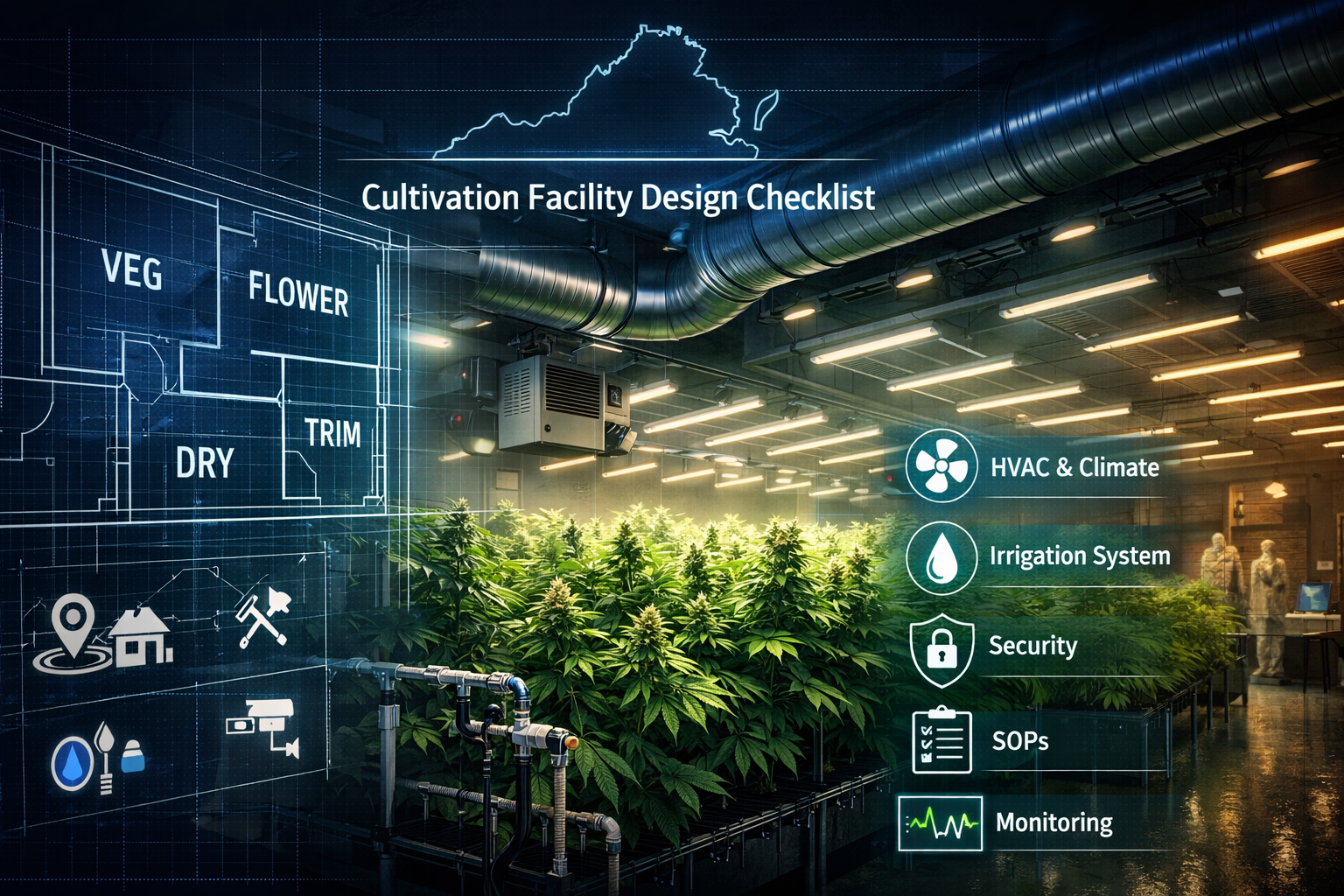
Section 1: Site Selection & Zoning
Confirm these items before signing any lease or purchase agreement.
- ☑️ Confirmed zoning classification permits cannabis cultivation at the proposed location
- ☑️ Local zoning and conditional use permit requirements reviewed — not assumed from state-level rules
- ☑️ Buffer distance requirements verified for all adjacent uses (schools, daycares, hospitals, residential zones)
- ☑️ Electrical service capacity confirmed — commercial cultivation typically requires 400A–2,000A+ three-phase service depending on canopy tier
- ☑️ Water supply capacity confirmed — both volume and pressure for irrigation systems at full canopy
- ☑️ HVAC infrastructure assessed — existing RTUs, ductwork, or mechanical rooms evaluated for retrofit suitability
- ☑️ Structural load capacity confirmed for ceiling-mounted lighting and HVAC loads (typically 15–25 lbs/sq ft additional dead load)
- ☑️ Drainage and waste management infrastructure verified — floor drains, runoff management, nutrient waste disposal pathway
- ☑️ Lease reviewed for cannabis-specific compliance — landlord consent, assignment rights, compliance obligations
- ☑️ Local authority pre-consultation completed — avoid sites where local political opposition will block permits
Section 2: Facility Layout & Design
- ☑️ Room plan designed around unidirectional product flow: propagation → vegetation → flower → harvest → dry/cure → packaging
- ☑️ Cultivation rooms sized to match your licensed canopy tier (Tier I–V) — do not design canopy that exceeds your license
- ☑️ Separate rooms for propagation, vegetation, and flowering — combined veg/flower rooms are a yield limitation
- ☑️ Harvest/processing room physically separated from live plant cultivation areas
- ☑️ Dedicated dry/cure room with independent HVAC control — never share HVAC with flower rooms
- ☑️ Packaging and vault storage area separated from cultivation and harvest areas
- ☑️ Employee entry/exit flow designed to prevent track-in contamination from exterior
- ☑️ Equipment maintenance access built into room design — 36–48 inches clearance behind all HVAC, lighting, and irrigation equipment
- ☑️ Hallways wide enough for equipment movement (grow lights, benching, harvest carts) — minimum 6 feet
- ☑️ Waste disposal flow designed — from cultivation rooms to secure waste staging area without passing through clean areas
Section 3: HVAC & Environmental Systems
HVAC is the highest-leverage — and most commonly under-specified — system in a cannabis cultivation facility. Virginia's humid climate makes this especially critical.
- ☑️ HVAC load calculation performed using sensible and latent heat loads for your canopy density and Virginia climate zone — not rules of thumb
- ☑️ Dehumidification capacity sized for peak transpiration rates (late flowering with full canopy) — Virginia's summer humidity makes undersizing this a critical error
- ☑️ Separate HVAC zones for each cultivation room — no shared air handling between rooms at different growth stages
- ☑️ Dedicated dry room HVAC capable of maintaining 60–70°F and 55–62% RH with 20–30 air changes per hour minimum
- ☑️ CO₂ supplementation system sized for room volume and target concentration (1,000–1,500 ppm during lights-on)
- ☑️ Air circulation within rooms designed to prevent canopy stagnation — adequate fan coverage for airflow at canopy level
- ☑️ Odor control — carbon filtration on exhaust systems sized for room volume and exchange rate
- ☑️ Room pressure relationships established — cultivation rooms slightly negative relative to hallways to prevent odor egress
- ☑️ Environmental monitoring with alerts — temperature, humidity, and CO₂ sensors at canopy level with 24/7 failure notifications
Section 4: Lighting Systems
- ☑️ PPFD targets established by growth stage — 600–800 µmol/m²/s for veg, 800–1,200 µmol/m²/s for flower
- ☑️ Fixture type (LED vs. DE-HPS) evaluated against Virginia utility rates and your projected production volume — LED typically delivers ROI within 2–3 years at commercial scale
- ☑️ PPFD uniformity map produced for your specific grow room dimensions — avoid hotspots above 1,500 µmol/m²/s and cold spots below 600 µmol/m²/s
- ☑️ Mounting height and fixture spacing specified to achieve target uniformity at canopy level
- ☑️ Lighting controllers with programmable schedules and dimming capability specified — not simple on/off timers
- ☑️ Electrical panel capacity confirmed for full lighting load plus 20% safety margin
- ☑️ UL or ETL listing confirmed on all fixtures — unlisted fixtures create insurance and permit compliance issues
Section 5: Irrigation & Fertigation
- ☑️ Irrigation system designed for your canopy configuration — drip emitter placement, header sizing, and zone mapping completed
- ☑️ Fertigation dosing system sized for target nutrient delivery volume and production schedule
- ☑️ Dead legs eliminated from all distribution lines — all terminal line ends have flush/bleed valves
- ☑️ Distribution lines sloped for complete drainage when not in use — standing water in lines is a microbial risk
- ☑️ ClO₂ injection point installed at irrigation header for continuous microbial control in distribution lines
- ☑️ Runoff collection and management system designed — substrate runoff must be managed and disposed of compliantly
- ☑️ Water filtration installed upstream of dosing system — sediment, chlorine, and pH pre-treatment as needed
Section 6: Security Systems
- ☑️ Video surveillance cameras in all areas containing cannabis plants or products — propagation, veg, flower, harvest, dry/cure, packaging, vault, and loading/unloading areas
- ☑️ Camera coverage confirmed at all entry and exit points for every secure area
- ☑️ Video retention system with storage capacity for the CCA-required retention period
- ☑️ Failure notification system with backup power capable of maintaining operation during power outages
- ☑️ Access control on all cannabis area entry points — keypad, key card, or biometric as specified by your security plan
- ☑️ Exterior perimeter lighting adequate to illuminate all entry/exit points and loading areas
- ☑️ Security system semi-annual testing scheduled and documented
Section 7: Materials & Build Specification
- ☑️ Grow room wall surfaces specified as cleanable and moisture-resistant — insulated metal panels (IMP) preferred over drywall in cultivation and post-harvest areas
- ☑️ Flooring specified as sealed, drainable, and chemical-resistant — sealed concrete or epoxy throughout grow rooms, harvest rooms, and dry rooms
- ☑️ Benching specified as open-frame stainless steel or food-grade aluminum — solid-top benches trap moisture and harbor contamination
- ☑️ HVAC ductwork specified as bare steel in grow rooms — no fiberglass duct liner in cultivation areas
- ☑️ Caulking and sealing plan for all penetrations, wall-floor junctions, and fixture mounting points
Section 8: Compliance Documentation
- ☑️ Seed-to-sale tracking system selected and enrollment initiated before plants are introduced
- ☑️ SOPs drafted for: room turn and sanitation, harvest, dry/cure, packaging, security, waste disposal, and employee training
- ☑️ Compliance inspection readiness checklist completed before CCA inspection — application plans must match actual facility
- ☑️ Canopy square footage documented and confirmed to match licensed tier limits
- ☑️ Staff training completed and documented before facility opens
The Cost of Missing Items on This Checklist
In our experience designing and optimizing cannabis facilities across multiple state programs, the most expensive design errors fall into three categories: HVAC undersizing (results in chronic microbial failures and yield deficits that compound with every harvest cycle), security system gaps (results in failed pre-licensing inspections that delay revenue by weeks or months), and layout errors (results in contamination exposure, labor inefficiency, and retrofits that cost 2–4x what the original design change would have cost).
Virginia's 24-month use-it-or-lose-it operational requirement makes design errors particularly costly. There is no tolerance for extended remediation timelines or delayed commissioning in a market where your license can be revoked for non-operation.
Get Expert Help With Your Virginia Facility Design
Urth & Fyre offers free facility assessments for Virginia cannabis license applicants. We've designed and optimized over 1,000,000 sq ft of commercial cannabis facilities, and we can evaluate your site concept, identify the critical design decisions for your specific license tier, and give you a realistic picture of what it takes to build a compliant, competitive Virginia cannabis operation.
For operators ready to move into design, our Cannabis Facility Design service covers everything from site feasibility through commissioning — with documented results including 985% ROI and 1,024% ROI outcomes for our clients. Contact us to get started.
Use the commercial grow room layout guide to coordinate racks, aisles, irrigation, airflow, and service access. Use the cannabis HVAC load and dehumidification guide to calculate sensible and latent requirements at crop conditions.
Tags
Latest Posts


Build a cannabis extraction equipment vendor shortlist with a step-by-step RFQ, evidence checklist, supplier profiles, scorecard, and acceptance-test plan.
A buyer's guide to cannabis testing lab equipment, from portable potency analyzers and HPLC through water activity, moisture and microbial tools.

%20(1).avif)
.avif)