
Virginia Cannabis Equipment Procurement Checklist: Source Smart for Your New License
Equipment is one of the largest capital expenditures in a Virginia cannabis cultivation or processing facility buildout — and one of the most commonly mismanaged. New market entrants routinely overbuy on specifications they don't need, underbuy on throughput capacity, purchase equipment incompatible with their facility design, or source used equipment without the technical validation needed to confirm it will perform.
Virginia's cannabis market creates specific equipment procurement pressures: a compressed timeline between license award and required operational readiness, a limited pool of experienced cannabis equipment vendors who understand Virginia's regulatory requirements, and the capital intensity of simultaneous facility buildout and equipment sourcing. Getting equipment procurement right requires a systematic approach — not just a vendor comparison.
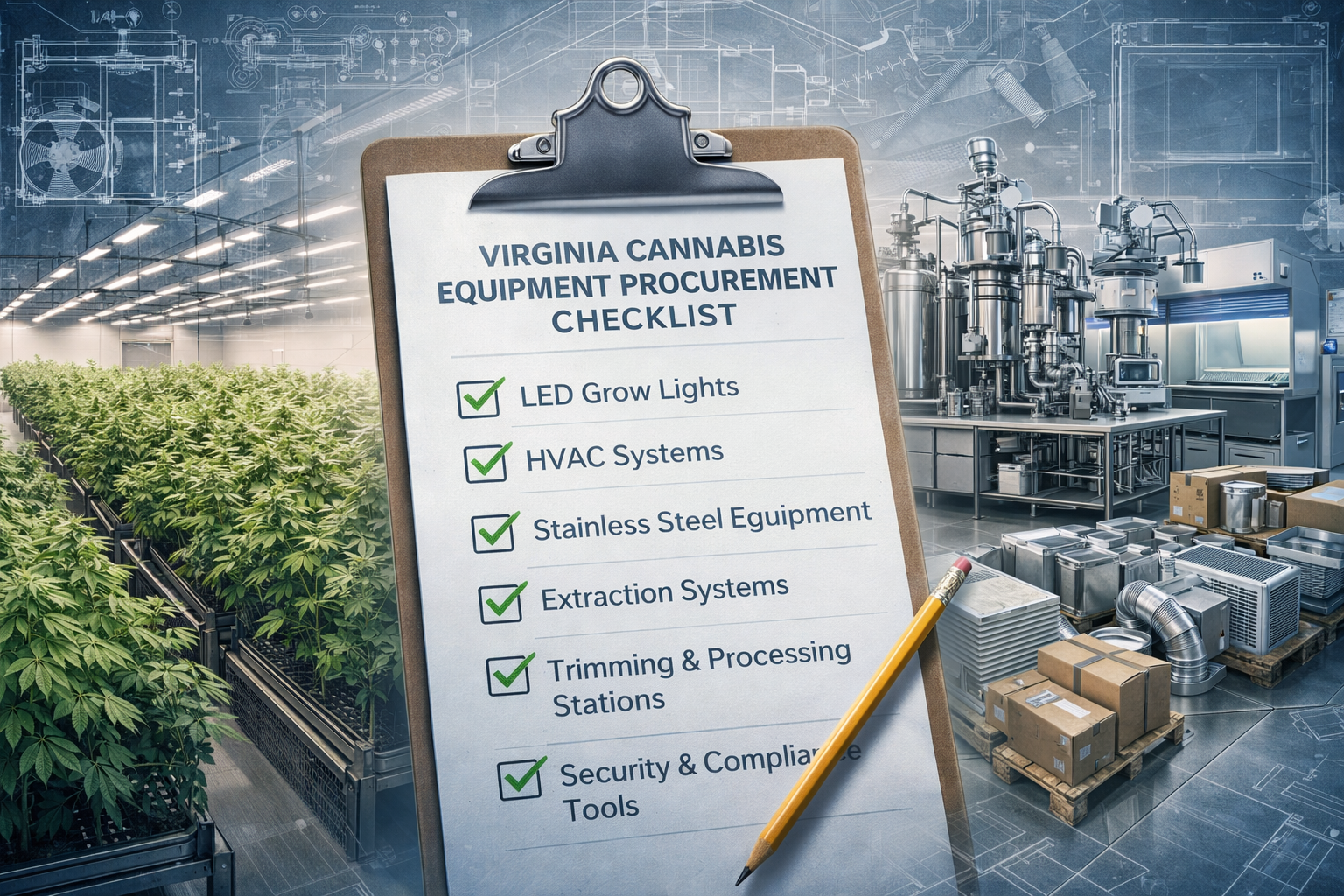
Section 1: Before You Buy Anything — Procurement Principles
- ☑️ Equipment list built from your production plan — not from vendor catalogs. Define your throughput targets, product mix, and operational workflow before evaluating equipment.
- ☑️ Equipment specified by function and performance requirement, not brand preference — define what throughput, capacity, accuracy, and operational parameters you need, then evaluate equipment against those specs
- ☑️ Total cost of ownership calculated — not just purchase price. Include installation, commissioning, operator training, consumables, maintenance contracts, and estimated downtime costs.
- ☑️ New vs. used decision made per equipment category — some equipment categories benefit significantly from purchasing used; others carry warranty and support risks that make new the better value
- ☑️ Lead time confirmed against your facility buildout timeline — major extraction systems, HVAC equipment, and custom-order items can take 8–16 weeks from order to delivery
- ☑️ Virginia regulatory compliance confirmed for each major equipment item — some processing equipment requires specific safety certifications (UL listings, NFPA compliance) that vary by state program
Section 2: Cultivation Equipment
Lighting Systems
- ☑️ Fixture type (LED or HPS/CMH) evaluated against your energy cost structure and canopy plan — in Virginia's utility rate environment, LED typically delivers ROI within 2–3 years over HPS at commercial scale
- ☑️ PPFD output and uniformity specifications confirmed — request IES photometric files or PPFD maps at your target mounting height, not just peak lux or watt ratings
- ☑️ Warranty terms confirmed — LED fixtures should carry minimum 3-year warranty; 5-year is the standard for commercial-grade products
- ☑️ Control compatibility confirmed — fixtures must be compatible with your chosen controller/dimmer system
- ☑️ UL or ETL listing confirmed — unlisted fixtures create insurance and permit compliance issues
HVAC & Dehumidification
- ☑️ Cooling and dehumidification capacity calculated by a mechanical engineer or certified HVAC designer — not sized from rules of thumb
- ☑️ Dehumidification equipment selected for Virginia's climate zone — Virginia's humid summers require robust dehumidification capacity that operators in arid western markets may underestimate
- ☑️ Dedicated HVAC unit specified per room — central HVAC shared across multiple rooms is a contamination and operational control risk
- ☑️ Backup dehumidification unit budgeted — a single-point-of-failure HVAC system in a cannabis grow room creates significant crop risk
- ☑️ Controls and monitoring integration confirmed — HVAC must interface with your environmental monitoring and alert system
Irrigation & Fertigation
- ☑️ Fertigation system capacity matched to your canopy area and target feed volume — undersized dosing systems create nutrient delivery inconsistencies at full canopy
- ☑️ Dosing system EC and pH control accuracy confirmed — target accuracy of ±0.1 EC and ±0.1 pH for precision fertigation
- ☑️ Irrigation line materials specified for chemical compatibility with your nutrient products
- ☑️ Pump capacity sufficient for simultaneous irrigation of all zones — pressure drop across all zones calculated before selecting pump size
- ☑️ Reservoir size adequate for your production schedule — minimum of one full day's irrigation volume as working capacity
Section 3: Processing & Extraction Equipment
Extraction Systems
- ☑️ Extraction method selected and confirmed against Virginia regulatory requirements
- ☑️ Extraction system capacity matched to your licensed biomass production — don't size extraction to your aspirational canopy; size it to Year 1 expected yield
- ☑️ Chiller capacity confirmed as a matched system with your extraction vessel — chiller BTU capacity, glycol loop sizing, and temperature range must match the extraction system's cooling demands
- ☑️ Ethanol recovery system included in the procurement plan — purchasing extraction without ethanol recovery creates a significant ongoing operating cost
- ☑️ Safety certifications confirmed — C1D1 or C1D2 compliance, pressure vessel certification, and UL/CE listings as applicable
Distillation Equipment
- ☑️ Distillation type selected based on your product mix — short path vs. wiped film distillation have different throughput profiles and distillate quality characteristics
- ☑️ Throughput capacity confirmed against your production target — wiped film distillation is generally preferred over short path for commercial scale
- ☑️ Chiller for distillation specified as a separate system from your extraction chiller — distillation cold trap requirements differ from extraction jacket cooling
- ☑️ Vacuum pump depth and capacity confirmed for your distillation system's operating pressure requirements
Filling & Post-Processing Equipment
- ☑️ Filling equipment selected based on your primary product format — vape cartridge fillers, tincture fillers, and edible production equipment have entirely different specifications
- ☑️ Viscosity range confirmed against your distillate or formulation — filling equipment has defined viscosity operating ranges; confirm yours falls within spec
- ☑️ Throughput matched to your production schedule — semi-automatic fillers (150–400 units/hour) are appropriate for different volume thresholds than automatic systems
- ☑️ Cleaning and sanitization requirements confirmed — food-grade and pharmaceutical-grade filling equipment must be disassembled and cleaned between product runs
Analytical & Testing Equipment
- ☑️ In-house testing scope defined — HPLC for potency, water activity meters for post-harvest QC, and microbial screening are the most common in-house investments
- ☑️ HPLC system selected based on your testing volume and analyte targets — entry-level systems ($15,000–$30,000 used) are appropriate for internal quality screening
- ☑️ Water activity meter procured for dry/cure quality control — calibrated water activity meters are required to accurately measure aw; moisture content meters do not substitute
- ☑️ Third-party testing lab in Virginia identified and relationship established before your first harvest — confirm accreditation, turnaround time, and pricing in advance
- ☑️ Sample management procedure defined — chain of custody from cultivation room to testing lab and back must be documented for compliance
Section 4: Used Equipment Due Diligence
Virginia's new market creates strong incentives to source verified used equipment — lower capital requirements, faster availability, and demonstrated performance histories. The following due diligence applies to any used extraction, distillation, processing, or analytical equipment purchase:
- ☑️ Equipment operating history confirmed — hours of operation, types of material processed, maintenance history, and any incidents (leaks, pressure events, electrical issues)
- ☑️ Physical inspection completed before purchase — remote inspection via video is acceptable; purchase without any inspection is not
- ☑️ Pressure vessels inspected for wear, pitting, or corrosion at all welded joints, fittings, and ports
- ☑️ Electrical components inspected — control panels, wiring, sensors, and controllers evaluated for condition and safety
- ☑️ Consumables inventory confirmed — gaskets, O-rings, seals, filters, and other maintenance items available and priced before purchase
- ☑️ Vendor support confirmed — does the original manufacturer still support this model? Are spare parts available?
- ☑️ Installation and commissioning support confirmed — complex extraction and distillation systems require professional installation
- ☑️ Title and lien-free status confirmed — in distressed seller situations, verify that equipment is not subject to a UCC lien or other encumbrance
The Equipment Mistakes That Destroy New Operator ROI
From our facility assessments across multiple state market launches, the equipment procurement mistakes that consistently destroy new operator ROI are:
- Oversizing extraction capacity for Year 1 — A $300,000 extraction system sitting at 20% utilization is $240,000 of idle capital. Start with the capacity you need for your licensed canopy at Year 1 production efficiency, not your aspirational capacity.
- Mismatched chiller-extractor combinations — Extractors and chillers must be matched as a system. Purchasing them independently and hoping they're compatible is one of the most common commissioning failures we encounter.
- Purchasing used equipment without an acceptance test protocol — Equipment that “ran fine at the last facility” may have deferred maintenance issues, calibration drift, or component wear that becomes your problem immediately. Always run an acceptance test before final payment.
- No spare parts inventory — The most expensive equipment is the equipment that's down. Build a spare parts inventory for all critical components — O-rings, gaskets, seals, filter elements — before your first production run.
- Ignoring commissioning timelines — Major extraction systems take 2–6 weeks to commission and dial in. Operators who plan to be production-ready the week after equipment delivery are consistently disappointed.
Equipment Sourcing for Virginia Operators
Virginia's new market creates specific equipment sourcing challenges. Supply chain timelines are compressed, vendor relationships haven't been established, and the risk of purchasing improperly specified or misrepresented used equipment is higher in the early-market chaos that typically accompanies a new state cannabis license round.
Urth & Fyre's Equipment Marketplace carries verified used and new extraction, processing, and lab equipment — including rotary evaporators, vacuum ovens, chillers, HPLC analyzers, filling machines, and wash machines — sourced and evaluated by operators who understand what cannabis facilities actually need.
For operators who want guidance on equipment specification before purchasing, our consulting engagements include equipment specification as part of the facility design scope — so you're buying equipment that fits your facility, your production plan, and your budget from day one.
Virginia is a new market. The operators who get equipment right — properly specified, properly sourced, properly commissioned — will establish production efficiency advantages over underprepared competitors that compound with every harvest cycle. Contact Urth & Fyre to discuss your Virginia equipment procurement plan, or browse our Equipment Marketplace to see what's currently available.
Build the funding package alongside the equipment schedule. The cannabis equipment leasing and financing guide compares structures, underwriting documents, condition evidence, and lender red flags.
Tags
Latest Posts


Build a cannabis extraction equipment vendor shortlist with a step-by-step RFQ, evidence checklist, supplier profiles, scorecard, and acceptance-test plan.
A buyer's guide to cannabis testing lab equipment, from portable potency analyzers and HPLC through water activity, moisture and microbial tools.

%20(1).avif)
.avif)