A cannabis flower room generates more moisture per square foot than almost any other indoor environment a mechanical engineer will design for. A mature canopy under full light transpires water all day, and every pint of that water has to be removed or the room slides into the conditions that grow powdery mildew and botrytis. Cannabis HVAC design is mostly a moisture problem wearing a temperature problem's clothes, and the facilities that fail almost always failed on latent load, not on cooling.
This guide covers the full climate design picture for indoor cultivation: how to calculate the load, why dehumidification dominates, how temperature and vapor pressure deficit work together, the system types that serve cannabis, and what it costs when the design is wrong. It is written to be the reference you cite, so it favors the underlying physics over product pitches.
Why cannabis is different from comfort cooling
Conventional building HVAC is sized for people. People add a modest, predictable amount of heat and moisture, and the system mostly fights solar gain and outdoor air. A grow room is the opposite. The occupants are plants that pump water into the air continuously, the lights add enormous sensible heat, and you deliberately seal the room against the outdoors. The result is a high latent load, a high sensible load, and almost no tolerance for the temperature and humidity swings a comfort system shrugs off.
Standard rooftop comfort units fail in cannabis for a specific reason: they are built to cool air, and they remove moisture only as a side effect of cooling. When your real problem is moisture and your cooling demand drops, for instance when the lights are off but the plants are still transpiring, a comfort unit stops dehumidifying right when you still need it. Designing hvac for cannabis means treating moisture removal as a primary, independently controlled function, not a byproduct.
Start with the load calculation
Every good cannabis HVAC design starts with an honest load calculation. Guessing here is what sinks projects. You are calculating two loads in parallel: sensible heat, which raises temperature, and latent heat, which is the moisture you must remove.
Sensible heat: lighting dominates
In an indoor grow, lighting is the largest sensible load by far. Essentially all the electrical power going into your fixtures ends up as heat in the room. A room running a high lighting power density puts a large, constant thermal load on the system whenever the lights are on. LED fixtures cut this compared to legacy HPS, but they do not eliminate it; the energy still becomes heat. Add pumps, dehumidifier compressors, and other equipment, and you have your sensible load. The lighting schedule also means this load switches on and off hard, and the system has to handle both states.
Efficient fixtures reduce the load you have to remove, which is why fixture selection and HVAC sizing are linked decisions. Resources like the DesignLights Consortium horticultural lighting listings help you compare fixture efficiency, which feeds directly into your cooling load.
Latent load: the canopy is a humidifier
The latent load is the moisture the plants transpire, and it is what makes cannabis HVAC hard. A healthy canopy can transpire most of the water you irrigate back into the air. At full flower under strong light, that is a large, continuous moisture load measured in pints or pounds of water per day across the room. This is the number that, when underestimated, produces mold, failed harvests, and lawsuits.
The key point is that the latent load does not track the sensible load. When the lights turn off, the cooling demand falls but the plants keep transpiring for a while, so the moisture load stays high while the cooling load drops. A system that only dehumidifies through its cooling coil loses the ability to remove moisture exactly when the room is most at risk. This decoupling is the single most important concept in cannabis climate design.
The authoritative methods for calculating these loads come from the ASHRAE Handbook, and cannabis specific load guidance is published by the Resource Innovation Institute, whose best practice work on controlled environment HVAC is the most cited in the sector and a good source to design against.
Dehumidification is the heart of the system
Because latent load drives the risk, dehumidification capacity is the number to get right first. There are two ways to remove moisture in a grow, and most facilities use both.
The cooling coil removes moisture as it cools air below the dew point and condenses water out. This handles much of the latent load while the lights are on and cooling is running. But it ties moisture removal to cooling demand, which is the decoupling problem above.
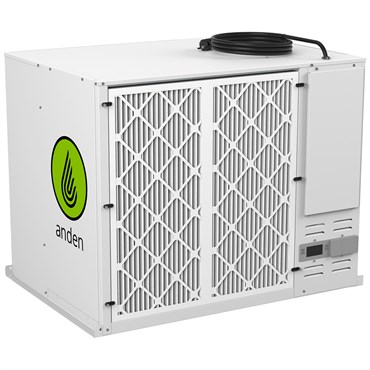
Standalone dehumidifiers remove moisture independently of cooling demand. They are what keep the room dry during lights off and during any period when cooling demand falls but transpiration does not. Sizing these is a discipline of its own. The Anden A710V3 removes 710 pints per day at 80 degrees Fahrenheit and 60 percent relative humidity, runs on 277 volt power, and is designed so it can operate on a 30 amp circuit where many competing units of similar capacity need a 50 amp breaker. Grow optimized dehumidification like this matters because the unit's capacity is rated at grow room conditions, not at the warmer, wetter test conditions that flatter a comfort dehumidifier's spec sheet.
Count your dehumidification capacity against your calculated latent load with margin, and verify the rated capacity is stated at conditions close to how you run the room.
Temperature, humidity, and vapor pressure deficit
Growers do not actually control temperature and humidity as separate goals. They control the relationship between them, expressed as vapor pressure deficit, or VPD. VPD measures how much more moisture the air could hold at the current temperature, which determines how readily the plant transpires. Too low a VPD and the plant cannot move water and nutrients, and the room is dangerously humid. Too high and the plant closes its stomata and stops growing to conserve water.
The practical consequence for HVAC is that temperature and humidity have to be controlled together, tightly, and held within a target band that shifts as the crop moves from vegetative growth to flower. A system that holds temperature but lets humidity wander, or vice versa, pushes the plants out of their VPD target even when one reading looks fine. This is why cannabis hvac systems need coordinated control of cooling, heating, and dehumidification rather than three devices fighting each other.
Reheat is part of this. When the cooling coil pulls air cold enough to wring out moisture, that air is often too cold to return to the room, so the system reheats it to the target temperature. Reheat lets you remove moisture without overcooling, and it is a normal, necessary part of a grow room HVAC design even though it looks wasteful to someone used to comfort systems. Energy recovery and hot gas reheat schemes recover some of that energy rather than burning it.
System types for cannabis cultivation
Several HVAC architectures serve cannabis, and the right one depends on facility size, redundancy needs, and budget.
Split and packaged direct expansion systems
Direct expansion systems, in split or packaged form, are common in smaller and mid size grows. They are relatively low in capital cost and simple to install, and paired with standalone dehumidifiers they serve many flower rooms well. Their limits show up at large scale, where running many separate units becomes hard to control and maintain, and where reheat and tight VPD control get awkward.
Chilled water systems
Larger facilities often move to chilled water. A central chiller plant produces cold water that is distributed to air handlers in each room. Chilled water scales efficiently, allows precise coil control and reheat, and centralizes the equipment that needs maintenance. The tradeoff is higher capital cost and design complexity, which pays back at scale through efficiency and control. For a multi room commercial grow room HVAC design, chilled water is frequently the right answer.
Dedicated systems with integrated dehumidification
A growing category is purpose built cannabis systems that integrate cooling, heating, dehumidification, and reheat in one controlled package designed for the latent loads and VPD targets of cultivation. These cost more than adapting comfort equipment, and they avoid the failure mode of a comfort system that cannot dehumidify during lights off. For operators who want the climate problem solved as a system rather than assembled from parts, they are worth pricing.
Air distribution and the canopy
Whatever the system type, air has to reach the canopy evenly. Dead spots hold moisture against leaves and become disease pockets, while excessive direct airflow stresses plants. Good cannabis HVAC design includes air distribution that keeps the canopy gently and uniformly moving air, often through dedicated circulation fans separate from the conditioning system. A perfectly sized system with poor distribution still grows mold in the corners.
Redundancy and the cost of failure
Climate failure in a flower room is not a comfort complaint, it is a crop loss. A dehumidifier that fails during flower can cost a harvest worth far more than the equipment. That economics drives redundancy decisions.
Designing for redundancy means the loss of one unit does not push the room out of its safe band. That can mean N plus one capacity, multiple smaller units instead of one large one so a single failure is partial, and monitoring with alarms that catch a drift before it becomes a problem. The cost of redundancy is small against the value of a flower room's annual output, which is why experienced operators build it in.
This is also where the cost of getting the design wrong shows up most starkly. An undersized system does not announce itself on day one. It fails on the hottest, wettest week of the year, or during the heaviest flower, when the load peaks and the system cannot keep up. By then the rooms are built and retrofitting is far more expensive than designing correctly the first time. The most expensive HVAC is the one you have to tear out and replace because it was sized to a guess.
Energy and operating cost
HVAC is one of the largest energy loads in an indoor grow, often rivaling lighting. Design choices compound over years of operation. Efficient fixtures reduce the cooling load. Chilled water and energy recovery cut operating cost at scale. Right sizing avoids both the failure of undersizing and the wasted capital and cycling losses of gross oversizing. Utility rebate programs sometimes offset efficient equipment, and the efficiency data behind those programs ties back to the same sources, ASHRAE methods, Resource Innovation Institute benchmarks, and DesignLights fixture data, that you used to size the system.
Operating cost and climate stability are not in tension. The same disciplined load calculation that keeps the room safe also keeps you from buying and running more equipment than you need. Cutting corners on design buys you both higher risk and higher long term cost.
Controls, monitoring, and commissioning
A correctly sized system still fails if its controls cannot hold the room together. Cooling, heating, dehumidification, and reheat have to be coordinated by a control system that targets the VPD band rather than letting each device chase its own setpoint and fight the others. Independent thermostats and humidistats with no coordination produce hunting, where one device overshoots and the next overcorrects, and the room never settles. A unified control strategy is part of the design, not an accessory.
Monitoring is what turns a drift into a caught problem instead of a lost crop. Sensors logging temperature, humidity, and ideally VPD across the room, with alarms that notify someone before conditions leave the safe band, are cheap against the value of a flower room. Place sensors at canopy level and in more than one location, because a single sensor near a supply vent reports the air it is bathed in, not the conditions the plants in the corner experience.
Commissioning closes the loop. A system should be tested against its design loads before the rooms are planted, ideally under conditions that approximate a full canopy and full light, so you find an undersized stage or a control conflict on an empty room rather than on a crop. Many climate failures were present from day one and simply did not surface until the room filled and the weather turned. Commissioning surfaces them while they are still cheap to fix.
Geography changes the outdoor side
The indoor loads are similar everywhere, but the outdoor conditions your system rejects heat into are not. A grow in a hot, humid climate rejects heat against a tougher outdoor condition than one in a cool, dry climate, which affects equipment sizing and efficiency. Humid regions also raise the stakes on any outdoor air the facility does bring in. None of this changes the canopy moisture load, but it changes how hard your equipment works to remove it and how you should size the heat rejection side. Design to your local design day conditions, the temperature and humidity extremes your region actually reaches, not to an average, because the system has to hold on the worst day, not the typical one.
How to approach a project
Sequence the work. Start with the load calculation, sensible and latent, building from your lighting power, room size, canopy, and irrigation. Size dehumidification to the latent load with margin and verify ratings at grow conditions. Choose a system type that matches your scale and redundancy needs. Design air distribution to the canopy. Build in monitoring and redundancy proportional to the crop value at risk. Each step depends on the one before it, and skipping the load calculation undermines everything downstream.
Because the loads interact and the cost of error is a lost crop, cannabis climate design is one of the highest stakes decisions in a buildout, and one of the easiest to get wrong without experience. Treat it as engineering, not as picking units from a catalog.
Worked cultivation load example
This example shows the calculation path, not a design value. Assume a room has 10,000 watts of lighting heat released inside, 3,000 watts of fans, pumps, and other internal equipment, and an estimated 8,000 Btu per hour from envelope and outside-air effects at one operating state.
- Lighting sensible load: 10,000 W × 3.412 = 34,120 Btu/h.
- Other electrical sensible load: 3,000 W × 3.412 = 10,236 Btu/h.
- Illustrative subtotal: 34,120 + 10,236 + 8,000 = 52,356 Btu/h, or about 4.36 refrigeration tons before project-specific allowances, diversity, duct heat, fan placement, altitude, or equipment performance corrections.
Now build the water balance. If irrigation supplies 80 gallons per day, 20 gallons leave as measured runoff, and 5 gallons remain in harvested material, media, or other accounted sinks, as much as 55 gallons per day remains to be explained. At 8.34 pounds per gallon, that is about 459 pounds of water per day. The hourly peak depends on irrigation timing, plant uptake, lights-on and lights-off transitions, room leakage, and storage in plants or media. Do not divide by 24 when moisture release is concentrated in a shorter window.
Calculate each operating state separately: lights on, lights off, irrigation, door opening, sanitation, upset, and recovery. Select equipment from sensible capacity, latent capacity, airflow, leaving-air conditions, part-load behavior, redundancy, controls, and capacity at the actual room condition.
Cultivation HVAC system comparison
| Approach | Best planning fit | Strengths to verify | Tradeoffs to model |
|---|---|---|---|
| Packaged or split direct expansion | Defined room zones and repeatable modular capacity | Local control, familiar service, staged redundancy | Part-load latent performance, outdoor derating, refrigerant circuits, roof or yard space |
| Chilled water with air handlers | Larger or multi-room plants with central utilities | Flexible coils, central heat rejection, plant-level redundancy options | Pumps, water treatment, controls, minimum load, operator skill, distribution losses |
| Integrated cultivation HVAC/dehumidification | Projects seeking coordinated sensible and latent control in one package | Single sequence and crop-oriented operating modes | Vendor concentration, service coverage, staging, capacity at room conditions |
| Cooling plus standalone dehumidification | Retrofit, supplemental latent capacity, or targeted redundancy | Independent moisture capacity and familiar equipment categories | Reheat interaction, competing controls, added heat, electrical demand, condensate |
| Dedicated outside-air system | Projects that separate ventilation-air treatment from room recirculation | Controlled ventilation and pressurization path | Not a substitute for crop sensible and latent capacity; coordinate sequences |
Compare complete systems at the same indoor and outdoor conditions, crop load, airflow, redundancy, controls, maintenance, and energy-rate assumptions. Link the calculation to facility design and cultivation consulting.