Commercial grow room design starts with the production calendar, plant sites, room turns, racking, irrigation, airflow, labor routes, sanitation, and equipment service access. Lay out warehouse or vertical rooms around those operating decisions, then calculate environmental loads. A floor plan that maximizes canopy but blocks maintenance, material movement, or uniform climate will underperform before the first harvest.
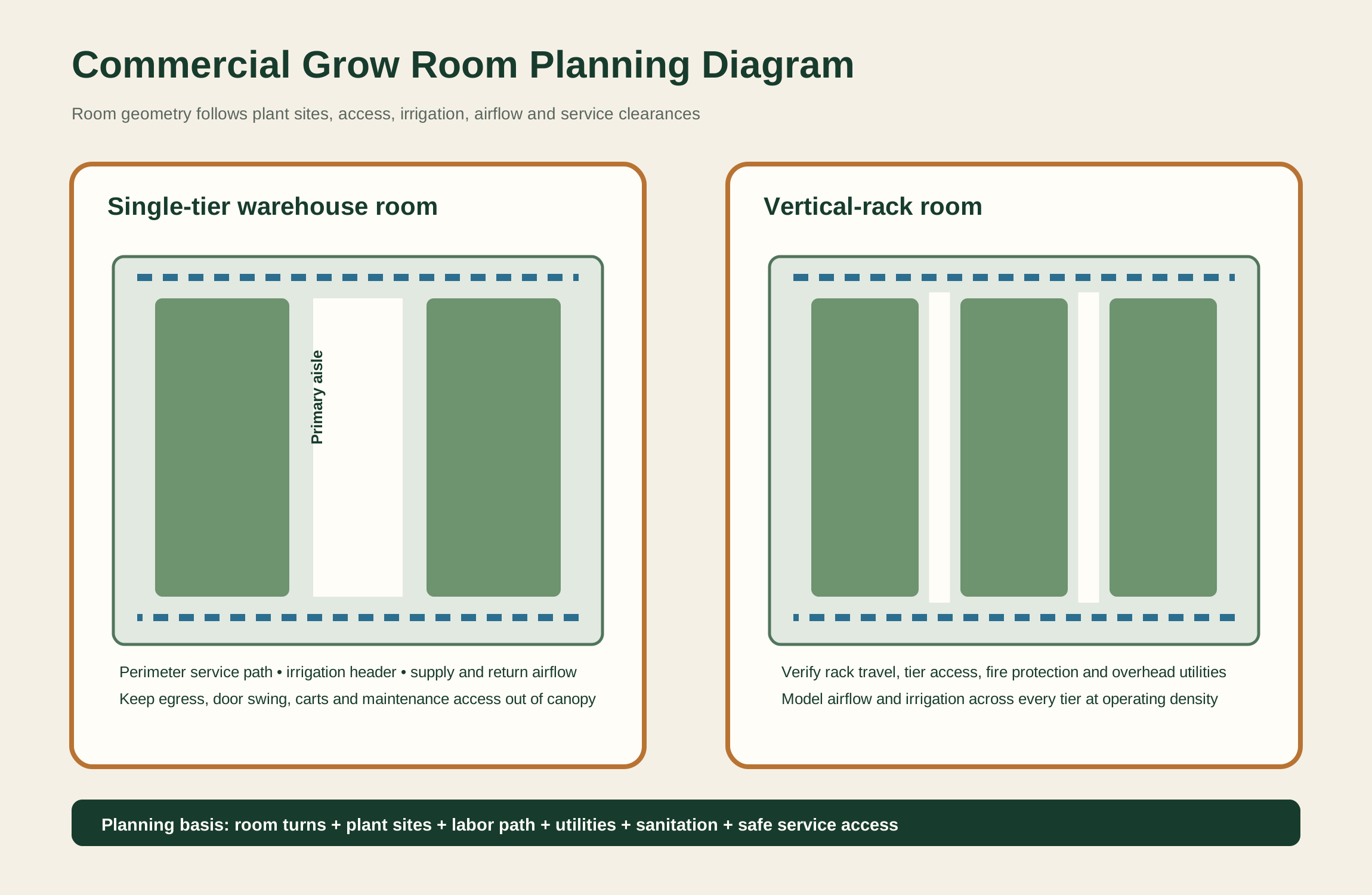
This guide walks the layout from the room dimensions out: how to size rooms, plan airflow and ventilation, choose single tier or vertical racking, integrate the climate system, and place the equipment. It assumes you know how to grow and want the building to stop getting in your way.
Design around the canopy, then the people, then the equipment
A useful order of priorities keeps layout decisions straight. The canopy comes first, because plant access to light and air is what produces yield. The people come second, because the room has to be worked safely and efficiently every day. The equipment comes third, fit around the first two without compromising either.
Operators who invert this, who lay out for the equipment or for maximum plant count and squeeze people and airflow into what is left, end up with rooms that are hard to work and prone to microclimates. Start from the canopy and the work, and the equipment placement usually resolves itself.
Room sizing and zoning
Commercial cultivation runs in stages: propagation, vegetative growth, and flower, often with mother plants and drying and curing as separate spaces. Each stage wants different light, climate, and access, so the building should be zoned into rooms matched to those needs rather than one large undifferentiated space.
Flower rooms are where the layout discipline matters most, because they carry the heaviest light, climate, and moisture loads. Sizing a flower room is a balance between the efficiency of a larger room and the risk concentration of putting too much crop under one climate system. Many operators favor multiple moderate flower rooms over one giant room, so a climate or pest problem is contained to a fraction of the harvest and so rooms can be cycled on staggered schedules for continuous output.
Veg and propagation rooms are smaller in footprint but need their own climate control, since their loads and targets differ from flower. Drying and curing rooms are climate critical in their own right and should be designed as deliberately as the grow rooms, not treated as leftover space.
Good commercial grow room design plans show these zones, the flow of plants between them, and the flow of staff and materials, before any racking or equipment is placed.
Layout patterns: warehouse and vertical
Two layout questions dominate: how you use the floor, and how you use the height.
Warehouse grow room design
A warehouse conversion is the most common commercial grow building, and warehouse grow room design has its own constraints. Existing column spacing, ceiling height, floor drainage, and power service all shape what is possible. The clear height between the floor and the lowest obstruction sets whether you can stack tiers and how tall the racks can be. Column grids dictate where walls and aisles can go without wasting space around structure. Survey these realities before you design the layout, because fighting the building is expensive.
Vertical grow room design
Vertical grow room design stacks canopy on multiple tiers to multiply production per square foot of floor. Where ceiling height allows, two or three tiers can double or triple the canopy a footprint supports. The catch is that every tier needs its own light and its own air movement, and the climate system has to deliver conditioned air evenly to every level. A poorly designed vertical room grows beautifully on the top tier and poorly on the bottom because air and light did not reach it equally. Vertical works when the airflow and lighting design keep up with the added canopy, and it fails when they are an afterthought.
The choice between single tier and vertical comes down to ceiling height, crop type, labor approach, and capital. Vertical raises yield per square foot and also raises the complexity of airflow, access, and climate delivery. It is a strong move in a building with the height and the climate design to support it, and a liability without both.
Racking and access
Racking holds the canopy and defines the aisles, so it sets how the room is worked. The tension is always between packing in canopy and leaving room to work and move air.
Aisles have to be wide enough for staff, carts, and any lifts needed to reach upper tiers, and they double as airflow paths. Too narrow and the room becomes dangerous and slow to work and air cannot move through the canopy; too wide and you give up productive space. Mobile racking, where rows roll on rails to open an aisle only where someone is working, recovers floor space in large rooms by eliminating fixed aisles, at the cost of equipment and complexity. Whether it pays off depends on the room size and how the crew works.
Plan access to every plant. A layout that leaves plants you cannot reach to scout, prune, and harvest creates pest and labor problems that compound over a cycle.
Airflow and ventilation
Air movement is where layout and climate meet, and it is the part most commonly underdesigned. There are two distinct jobs: moving air through and around the canopy, and conditioning the room's overall climate.
Canopy airflow
Every leaf needs gentle, consistent air movement to transpire properly and to avoid the still, humid pockets where disease starts. This is the job of circulation fans, placed to keep air moving uniformly across the whole canopy without blasting plants. In a vertical room, each tier needs its own circulation. Dead spots are where botrytis begins, so canopy airflow is a disease prevention system as much as a growth one.
Room ventilation and the seal
Grow room ventilation design depends on whether the room is sealed or uses outside air. Sealed grow room design, the dominant approach in commercial cannabis, isolates the room from the outdoors and controls everything mechanically: CO2 enrichment, temperature, and humidity all held by the equipment without exchanging air with the outside. Sealing lets you enrich CO2 and keeps pests, spores, and outdoor humidity out, but it puts the entire climate burden on your mechanical system, with no outdoor air to bail you out. That makes the climate system design, covered next, non negotiable.
The alternative, bringing in and exhausting outside air, lowers mechanical load but exposes the room to outdoor conditions, pests, and contaminants, and makes CO2 enrichment impractical. Most serious commercial operations seal and condition mechanically for the control it gives.
Integrating the climate system
In a sealed room, the climate system is not an add on, it is part of the room's structure. Where the air handlers, dehumidifiers, and ducts go shapes the layout, and the layout shapes how evenly conditioned air reaches the canopy. Design them together.
The dominant load in a flower room is the moisture the canopy transpires, and that latent load does not fall when the lights and cooling demand drop. A room that holds temperature but lets humidity drift will push plants out of their target and breed disease. Sizing and placing the climate and dehumidification equipment is its own discipline, and it interacts with every layout decision above. We cover it fully in the cannabis HVAC pillar, the complete cultivation climate guide, and any grow room hvac design should be done alongside the physical layout, not after it.
The practical rule: do not finalize racking and aisles until you know where conditioned air enters and how it reaches every part of the canopy, including the lower tiers of a vertical room. Layout and airflow are one problem.
Power, water, and the unglamorous systems
A commercial grow is also an electrical and plumbing project. Lighting, climate equipment, pumps, and controls draw heavy, continuous power, and the building's service has to support the full connected load with margin. Undersized electrical service is a common and expensive surprise in warehouse conversions.
Water and drainage matter as much. Irrigation supply, runoff capture, and floor drainage all have to be designed in, and floors should be sloped and sealed for washdown and sanitation. Retrofitting drainage into a finished room is miserable, so plan it at design.
Build these into the layout from the start. The placement of electrical rooms, water treatment, and drainage affects where everything else can go.
Compliance and security in the layout
Cannabis cultivation layouts also have to satisfy state rules, which commonly dictate security, access control, surveillance coverage, and separation of areas. These are not paperwork you bolt on later; they constrain the floor plan. Camera coverage requirements affect sightlines and wall placement, access control affects door and room arrangement, and some states mandate specific separations. Read your state cultivation facility regulations before you finalize the layout. Engineering references for controlled environment agriculture from bodies like ASABE and cultivation benchmarks from the Resource Innovation Institute help you design to recognized standards, and your state's cannabis regulator publishes the rules that constrain the plan.
The equipment that goes in
Once the rooms, racking, airflow, and climate are designed, the equipment list follows from them: lighting matched to the canopy and tier height, circulation fans for the canopy, climate and dehumidification sized to the loads, irrigation and fertigation, CO2 supply for sealed rooms, racking and any mobile systems, and the controls and monitoring that tie it together. Choosing this equipment well, and matching it to the layout rather than the reverse, is where experience pays off. Our cultivation and equipment consulting helps operators specify and source the gear so it fits the room and the budget.
Material flow and daily work
A layout is also a workflow. Plants move from propagation to veg to flower to harvest, and staff and materials move through the building every day. A good plan makes those flows short, logical, and one directional where it matters, so clean and dirty areas do not cross and finished product does not backtrack through cultivation.
Think about where biomass enters and leaves, where trimming and drying happen relative to the grow rooms, and how staff move between zones without carrying pests or contaminants from one room to the next. Long, awkward, or crossing paths cost labor on every cycle and raise contamination risk. The rooms can be sized perfectly and still produce a building that is slow and risky to work if the flow between them was an afterthought.
Sanitation drives the same thinking. Rooms and corridors should be designed to be cleaned, with surfaces and drainage that allow washdown and a layout that lets staff sanitize between cycles without disrupting active rooms. Designing the flow and the sanitation in from the start costs nothing extra at the planning stage and saves labor and crop risk for the life of the building.
Designing for yield and return
Layout is an economic decision. Every square foot of building costs rent, power, and labor whether it grows or not, so the layout that produces the most sellable product per square foot, safely and repeatably, wins. That is rarely the layout that simply maximizes plant count; it is the one that balances canopy, access, airflow, and climate so the whole room produces consistently. For the math on how layout decisions translate into yield and payback, see facility optimization and ROI, which connects the design choices here to the numbers that justify them.
Room sizing and access schedule
| Input | How to size it | Evidence to preserve |
|---|---|---|
| Plant sites and canopy | Room-turn plan, plant density, licensed definition, rack levels, and usable growing area | Premises diagram, rack plan, cultivation schedule |
| Primary aisles | Carts, harvest movement, emergency access, doors, and local code minimums | Scaled route test with widest load |
| Rack and bench clearance | Movement envelope, worker position, cleaning, irrigation, lighting, and fire protection | Vendor drawings and service procedure |
| Perimeter service zone | Coils, valves, filters, sensors, drains, panels, and replacement access | Maintenance task and rigging review |
| Irrigation zone | Headers, pressure regulation, drains, leak containment, flushing, and controls | Piping diagram and sanitation plan |
| Harvest and sanitation staging | Peak batch, tote count, tools, waste, clean equipment, and room reset | Observed or simulated room turnover |
Do not publish generic aisle or canopy ratios as a design rule. Dimensions must reconcile the adopted code, license definition, rack and equipment drawings, worker tasks, carts, accessibility, fire protection, and AHJ review.
Airflow and equipment coordination table
| Design question | Room evidence | Commissioning check |
|---|---|---|
| Can supply air reach every plant zone? | Diffuser layout, rack geometry, canopy density, fan locations | Air movement and environmental mapping at operating density |
| Can return air leave without short-circuiting? | Return path, obstructions, door position, equipment heat | Temperature and humidity recovery after representative disturbances |
| Can dehumidification follow transpiration? | Plant count, irrigation, lights, day and night schedules | Moisture removal under peak crop and lights-off transition |
| Can staff maintain the system safely? | Filter, coil, sensor, valve, drain, and electrical access | Observed maintenance and energy-isolation task |
Sealed-room pressure, odor, and biosecurity
A sealed room is still part of a building pressure and contaminant-control system. Define pressure relationships among cultivation, corridors, propagation, quarantine, dry rooms, processing, waste, and outdoors. Decide where air may transfer, where it must not transfer, and what happens when doors open or an exhaust system starts. Pressure direction should follow the facility risk assessment, not a universal positive or negative rule.
Coordinate odor treatment, outside air, relief, exhaust, carbon dioxide, doors, vestibules, filtration, sanitation, pest exclusion, and emergency modes. Verify sequences during startup and under crop load. The cannabis HVAC design guide owns load calculations and system architecture. Urth & Fyre's cultivation consulting, facility design service, and cultivation optimization assessment connect the room plan to operating performance.
FAQ
How do I lay out a commercial grow room?
Design around the canopy first, then the people who work the room, then fit the equipment around both. Zone the building by growth stage, size flower rooms to balance efficiency against risk concentration, plan aisles wide enough to work and move air, and design airflow and climate alongside the physical layout rather than after it.
Should I build a single tier or vertical grow room?
Vertical grow room design multiplies canopy per square foot by stacking tiers, which pays off in buildings with the ceiling height and the airflow and lighting design to serve every level evenly. Single tier is simpler and avoids the airflow complexity. Choose based on clear height, crop type, labor approach, and capital.
What is the difference between a sealed and ventilated grow room?
Sealed grow room design isolates the room from the outdoors and controls temperature, humidity, and CO2 entirely with mechanical equipment, which allows CO2 enrichment and keeps pests and spores out but puts the full climate load on your system. Ventilated rooms exchange air with the outside, lowering mechanical load but exposing the room to outdoor conditions and making CO2 enrichment impractical. Most commercial operations seal.
How important is airflow in grow room design?
It is critical and commonly underdesigned. Canopy airflow keeps every leaf transpiring and prevents the still, humid pockets where botrytis and mildew start, and it is separate from the room's overall conditioning. In a vertical room, each tier needs its own circulation. Do not finalize racking and aisles until you know how conditioned air reaches every part of the canopy.
What should I plan before finalizing a warehouse grow layout?
Survey the building's clear height, column spacing, floor drainage, and electrical service first, since these constrain what the layout can be. Plan power, water supply, drainage, and the climate equipment placement into the design from the start, and check your state's security and separation rules, which shape the floor plan.
Planning a build or retrofit? Book a cultivation or facility consult and we will design the layout, airflow, and equipment together so the room works from the first cycle.

Founder of Urth & Fyre. 1M+ square feet of cannabis facilities designed and optimized. Every answer on this site is his.
About Trevor →