Mississippi cannabis licensing, facility design and equipment.
How to open a dispensary in Mississippi: apply to the Department of Revenue, which takes dispensary applications year round and issues a license within 30 days of a complete file. The medical-only program had 171 dispensaries and 110 cultivators at the end of 2025. No license cap or application deadline exists as of Nov. 2026.
Rolling applications open; 171 dispensaries and 66,041 patients at Dec. 2025; HB 895 vetoed March 2026
Syncing and validating with
Where Mississippi is today
Mississippi is medical only with two regulators. The Mississippi State Department of Health Medical Cannabis Program licenses cultivation, processing, testing and transport; the Department of Revenue licenses dispensaries. Both take applications year round with no cap and decide within 30 days.
Dispensaries fell from 200 to 171 in 2025 while patients rose to 66,041. The governor vetoed HB 895 in March 2026, so the 60% THC cap on concentrates stands. Compare cannabis licensing in every state.
- 2022. SB 2095, the Mississippi Medical Cannabis Act (Miss. Code 41-137-1 to 41-137-67), becomes law.
- Oct. 11, 2023. The Board of Health adopts revised Title 15 Part 22 rules.
- April 1, 2024. MDOR's opt-out map lists 80 cities and 17 counties.
- Dec. 15, 2025. MSDH counts 66,041 patients, 110 cultivators and 37 processors; dispensaries total 171 on Dec. 29.
- March 2026. Gov. Reeves vetoes HB 895; applications stay open into 2027.
How to get a Mississippi cannabis license
- Pick the regulator. Dispensaries file with MDOR online; cultivation, processing, testing and transport file with MSDH. Both decide within 30 days.
- Clear the site first. Check the opt-out map, confirm commercial zoning, and survey 1,000 feet from any school, church or child care line and 1,500 feet from the nearest dispensary.
- Fund fees and build. A dispensary costs $40,000 in year one; a Tier 3 grow costs $70,000. Test the tier with cannabis financial modeling.
- Assemble the file. Sales tax permit, fingerprint checks on every owner, premises diagram, operations plan and a security plan showing every camera and door.
- Start the right design. Dispensary plans: lay out sales floor, vault and video storage with cannabis facility design inside the 18 month clock. Cultivation and processing plans: begin facility design for new licenses for a fully enclosed indoor building.
What the state issues, and what each one needs built
- Dispensary (MDOR). In-store sales to cardholders only. $15,000 application fee plus $25,000 annual fee; $25,000 renewal. 171 licensed at Dec. 29, 2025; 18 months to pass final inspection if still under construction.
- Cultivation (MSDH). Micro Tier 1 (up to 1,000 sq ft, $1,500 application, $2,000 annual) and Micro Tier 2 (to 2,000 sq ft, $2,500, $3,500) require owners with three years of state residency. Tiers 1 to 6 run 2,000 to 150,000 sq ft of canopy at $15,000 to $150,000 a year. 110 licensed.
- Processing and testing (MSDH). Micro processors under 3,000 lb a year pay $3,500 or $5,000 annually; full processors $15,000 and $20,000, plus a food permit for edibles. Labs pay $10,000 and $15,000; only 2 were licensed at the end of 2025.
What a Mississippi facility costs to design and build.
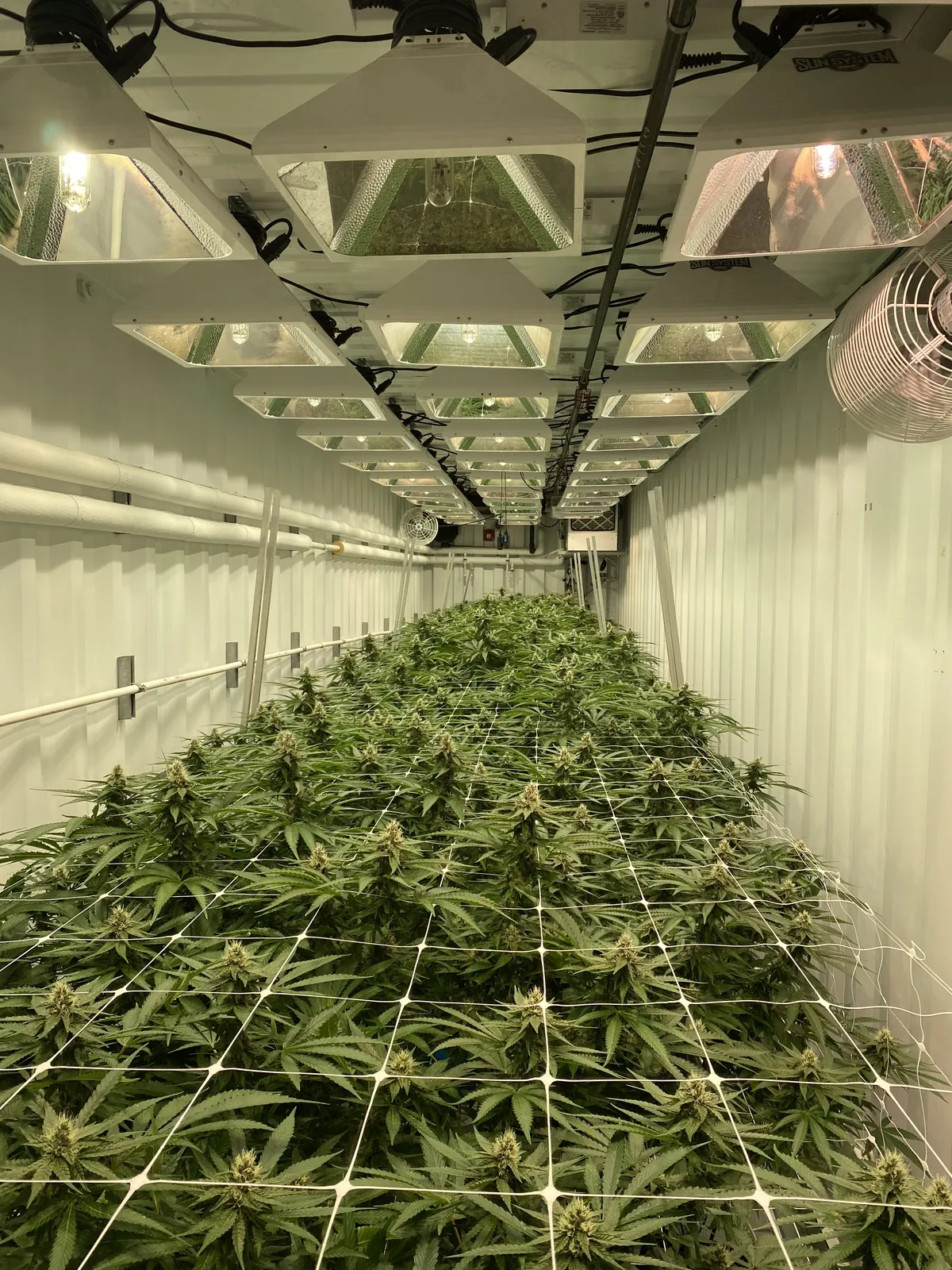
Size the grow to the tier you can fill. A Tier 2 building with 15,000 sq ft of canopy needs about 25,000 sq ft of floor area, which at $150 to $500+ per sq ft runs $3.75 million to $12.5 million or more before $35,000 in fees for year one. Design takes 30 to 60 days and the build 3 to 6 months after permits, so a dispensary on its 18 month clock needs zoning and the 1,000 foot survey cleared before the lease.
Power: Mississippi's average commercial electricity price was 13.20 cents per kWh in 2025 against a U.S. average of 13.37 cents, per EIA Electric Power Annual, Table 2.10. Indoor cultivation is mandatory in a humid subtropical climate, so dehumidification is the largest load after lighting; model it per room with Urban Farms HVAC. 80 cities and 17 counties had opted out of dispensaries on MDOR's map as of April 1, 2024; grow sites carry the same 1,000 foot setback (Rule 5.4.3).
Mississippi specifics
Testing. Every batch (25 lb cap) is tested for potency, pesticides, heavy metals, mycotoxins, microbials and foreign material, plus residual solvents on concentrates. Flower fails above 30% total THC, concentrates above 60%, water activity above 0.65 (Rules 1.7.6 and 1.7.7).
Security. Grow and processing sites need 24/7 alarms that run through a power outage, lighting for continuous video, commercial grade locks and 120 days of video archive (Rules 5.10.6 to 5.10.9). Dispensaries record at 1080p (Rule 35.XI.11).
Tracking. Metrc is the state seed-to-sale system; labs upload results within one business day.
Packaging and edibles. Child-resistant and resealable for multi-serving products (16 CFR 1700.15). Labels state THC per serving and per package; above 30% total THC the label reads extremely potent. One MMCEU equals 100 mg THC in an infused product.
| Topic | Mississippi rule | Design response |
|---|---|---|
| Indoor cultivation | Rule 5.10.5: all cultivation indoors in enclosed, locked facilities | Sealed rooms with HVAC sized for Gulf humidity and Anden dehumidifiers |
| Canopy tiers | Fees step from 1,000 sq ft micro to 150,000 sq ft Tier 6 | NextGen rolling benches planned to land under the tier line |
| Solvent extraction | Rules 6.11.8 to 6.11.14: 99% pure hydrocarbon, ventilation, ignition control, gas detection | C1D1 room in the MEP set (C1D1 room requirements), used Precision Extraction systems |
| Potency and edibles | Concentrates capped at 60% total THC; edibles need a food permit | Dilution and dosing in a food grade kitchen (edibles equipment), Coldelite confection lines |
What the same work did for an operator like you
What a Mississippi applicant gets from the design desk.
- A Mississippi cannabis compliance review of your premises diagram and security plan against Title 15 Part 22
- Cannabis facility design for an indoor grow sized to a canopy tier, plus processing and dispensary back of house
- A cannabis facility design package in 30 to 60 days: room program, MEP set, equipment schedule
- Extraction rooms specified from our cannabis extraction equipment guide to the 60% concentrate cap
Mississippi questions
How do I open a dispensary in Mississippi?
Apply to the Department of Revenue online with a sales tax permit, owner background checks, a premises diagram, an operations plan and a security plan. The site must be zoned commercial, 1,000 feet from schools, churches and child care, and 1,500 feet from another dispensary. MDOR decides within 30 days.
How much does a dispensary license cost in Mississippi?
$40,000 in the first year: a $15,000 nonrefundable application fee and a $25,000 annual license fee, then $25,000 a year to renew. A dispensary under construction must pass final inspection within 18 months of licensure.
What are the Mississippi cultivation license tiers?
Two micro tiers (up to 1,000 and 2,000 sq ft of canopy, $2,000 and $3,500 a year) for owners with three years of state residency, and six standard tiers from 2,000 to 150,000 sq ft at $15,000 to $150,000 a year. All cultivation must be indoors in an enclosed, locked building.
Is there a cap on Mississippi medical cannabis licenses?
No. The Act sets no limit on dispensaries, cultivators or processors, and both regulators accept applications year round. Dispensaries fell from 200 to 171 in 2025 while patients grew to 66,041, so new entrants compete on location and cost.
Did Mississippi change its cannabis law in 2026?
No. Gov. Reeves vetoed HB 895, which would have removed the 60% THC potency limit on tinctures, oils and concentrates, and the 60% cap still appears in the testing and dispensary rules. For a neighboring adult use market, see Missouri cannabis licensing.
Where the Mississippi rules on this page come from
- MSDH Medical Cannabis Program: Business FAQ, fees, Metrc, security, labeling
- MSDH CY 2025 Annual Report, licensee and patient counts
- MDOR: Dispensary Applicants, fees, siting
- MDOR: Dispensary Opt-Out Map
- MDOR Title 35 Part XI, distances, cameras, potency caps
- MSDH Title 15 Part 22 Subpart 5, Cultivation, indoor rule, security
- MSDH Title 15 Part 22 Subpart 6, Processing, extraction, packaging
- Governor's veto message, HB 895 (2026)
- EIA Electric Power Annual, Table 2.10 (2025)
Regulator: Mississippi State Department of Health, Medical Cannabis Program. Last reviewed November 7, 2026.
 Record last reviewed