Texas cannabis licensing, facility design and equipment.
Texas runs a low-THC medical program through DPS. HB 46 added 12 dispensing organization licenses, and each new licensee has 24 months to become fully operational.
Low-THC medical program; 12 new dispensing organization licenses under HB 46
Syncing and validating with
Where Texas is today
The Texas Compassionate Use Program (TCUP) is run by the Department of Public Safety under Senate Bill 339 (2015). HB 46 (2025) expanded it: 12 new dispensing organization licenses for a total of 15, satellite dispensaries, and new qualifying conditions and product forms.
- 2015. SB 339 creates the Compassionate Use Program.
- August 15 to September 15, 2025. DPS takes applications for the new licenses.
- September 1, 2025. HB 46 takes effect: 12 new dispensing organization licenses.
- December 2025. Phase I: nine conditional licensees named.
- April 2026. Phase II: three more selected for due diligence.
- Within 24 months of licensure. Each new licensee must be fully operational.
How to get a Texas cannabis license
- Know the window. DPS is not taking new dispensing organization applications as of October 2026. Its last window ran August 15 to September 15, 2025, for the 12 new licenses HB 46 authorized. Compare the path with Texas and the other state programs.
- Understand the one license. Texas licenses a dispensing organization to cultivate, process and dispense low-THC cannabis. There is no separate grow license or dispensary license, and HB 46 sets the total at 15.
- Watch the eligibility list. DPS placed 12 businesses on a license eligibility list for possible future review and will refer to it if a licensee fails to become operational. Everyone else waits for the next window DPS announces.
- Budget the license. A new license is $488,520 for two years and the biennial renewal is $318,511. The application fee is non-refundable, and DPS invoices license fees only after an applicant passes due diligence.
- Plan the 24 months now. A licensee must be fully operational within 24 months of licensure, and a conditional license does not allow cultivation, manufacturing or sales until DPS grants final approval. Design the facility around the equipment list before the award, not after.
- Design for finished goods. Products are capped at 10 mg of THC per dosage unit and 1 g of THC per package, so the building is an extraction and dosing plant as much as a grow. The distillation equipment guide covers the refinement step.
- Take the right next step. Dispensary-only applicants: dispensing happens only under a dispensing organization license and its satellite locations, so start with Texas cannabis compliance before committing to a full application. Cultivation and processing applicants: start with new license facility planning built around the 24-month clock.
What the state issues, and what each one needs built
- Dispensing organization: cultivates, processes and dispenses low-THC cannabis. 15 total after HB 46.
- Conditional licenses do not allow cultivation, manufacturing or sales until DPS grants final approval.
- Satellite dispensaries are allowed under HB 46.
What a Texas facility costs to design and build.
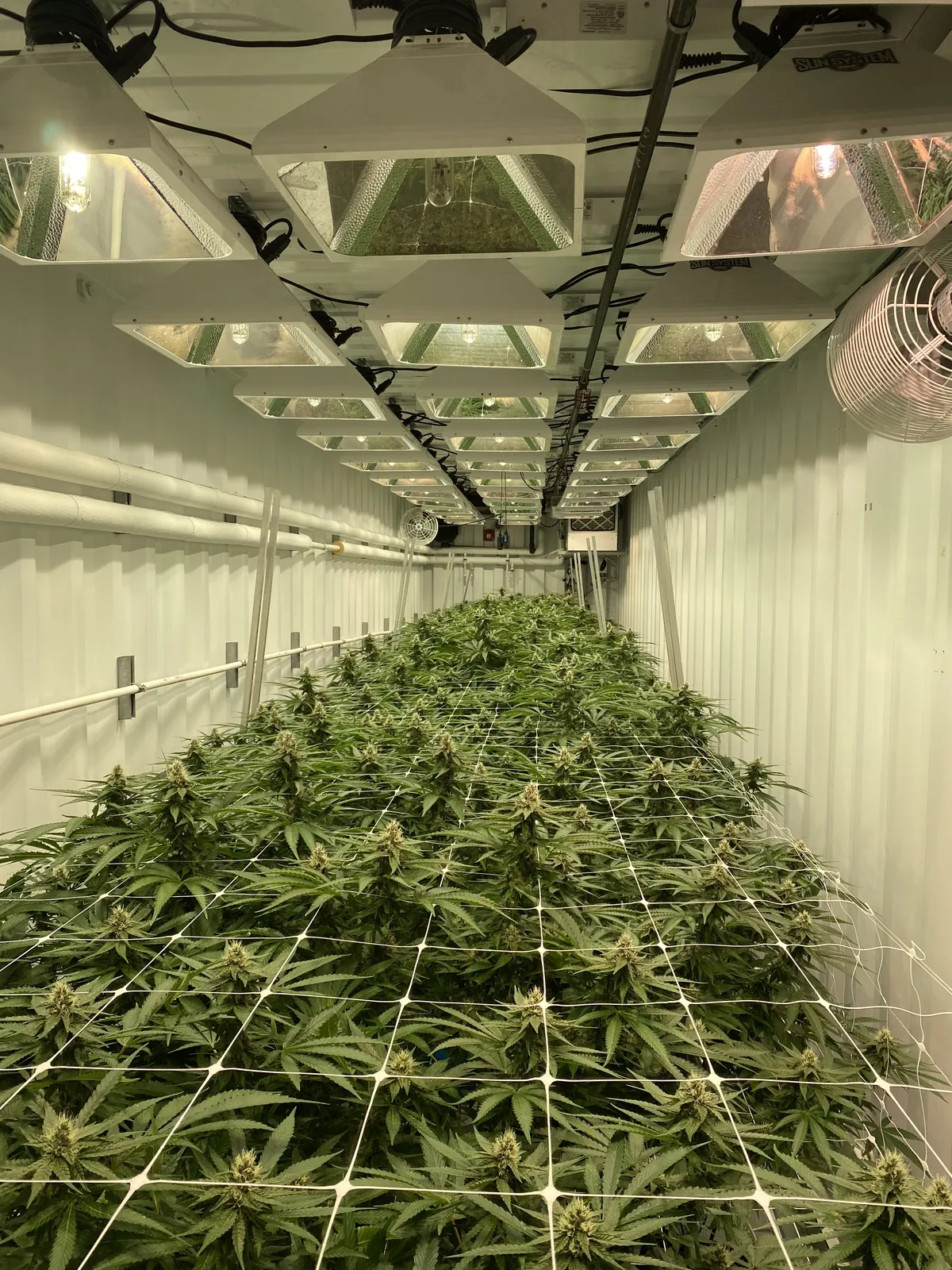
Texas sets no canopy tier, so the license does not size the building; the product line does. A dispensing organization pays for cultivation rooms, an extraction suite, a dosing and packaging room and a vault under one license. As a planning example, a 20,000 sq ft building at $150 to $500+ per sq ft runs $3M to $10M+, before the $488,520 two-year license fee.
Power: The Texas commercial average was 8.56 cents per kWh in 2025, compared with 13.37 cents for the U.S. (EIA Electric Power Annual, 2025 commercial average). Lighting, cooling and dehumidification carry most of a sealed flower room's load, so price them at that rate with the cannabis HVAC design guide.
Local permitting: Texas law bars cities and counties from adopting rules that prohibit the low-THC cannabis the program authorizes (Health and Safety Code § 487.201). That keeps local bans off the table; the schedule risk is the build. A design package takes 30 to 60 days and the build runs 3 to 6 months after permits, which fits the 24-month deadline when design starts before the award. The vertically integrated licensees in Florida licensing and facility rules also build on a deadline.
Texas specifics
HB 46 caps products at 10 mg of THC per dose and 1 gram of THC per package. Texas law defines medical use as administration by any means other than smoking, so the facility is built around extraction and finished-product manufacturing.
| Topic | Texas rule | Design response |
|---|---|---|
| Dose limit | 10 mg THC per dosage unit; smoking is not a permitted medical use | Potency checks on every batch with in-house testing lab equipment |
| Package limit | 1 g THC per package or inhalation device | Fill line with NTEP checkweighing to hold the cap |
| Tracking | No state tracking system: 37 TAC 12.8 requires a licensee-run perpetual inventory control system that tags each plant and interacts with the DPS registry | Tag points, post-dry weigh stations and a monthly count area in the room-by-room layout |
| Time to operate | Fully operational within 24 months of licensure | Design and build schedule set against the 24 months, starting from the grow room equipment list |
| Local rules | Cities and counties may not prohibit the program's low-THC cannabis (Health and Safety Code § 487.201) | Site search driven by power, water and building fit, with a power quality plan for the extraction suite |
| Extraction, odor, security, water | Set in DPS rules | Designed to the DPS rule; C1D1 room and ventilation in the design package |
What the same work did for an operator like you
What a Texas applicant gets from the design desk.
- A cannabis facility design for a vertically integrated site: cultivation rooms, extraction suite, dosing room and vault on one plan
- A cannabis facility design package in 30 to 60 days, scheduled against the 24-month operating deadline
- An extraction and finished-goods line sized to the 10 mg dose and 1 g package caps, chosen with our cannabis extraction equipment guide
- Cannabis financial modeling that carries the $488,520 license fee and the $318,511 renewal
Texas questions
How do I get a grow license in Texas?
Texas has no standalone grow license: cultivation is licensed only as part of a dispensing organization, which DPS licenses to cultivate, process and dispense low-THC cannabis. The last application window closed September 15, 2025, and no new window is open as of October 2026. A cultivation business plan written now puts you ahead when DPS announces the next one.
Can I open a dispensary in Texas?
Only as a licensed dispensing organization or one of its satellite locations; Texas has no standalone dispensary license. HB 46 lets a dispensing organization run satellite locations in addition to its primary location. DPS keeps 12 businesses on an eligibility list for possible future review.
Is Texas issuing new cannabis licenses?
HB 46 authorized 12 new dispensing organization licenses. DPS named conditional licensees in two phases (December 2025 and April 2026); final licenses follow due diligence.
How long does a new Texas licensee have to open?
Each new dispensing organization must be fully operational within 24 months of licensure.
How much does a facility cost?
Indoor builds run $150 to $500+ per square foot depending on the room program and envelope. The DPS license fee is $488,520 for a new two-year license and $318,511 for each biennial renewal.
How long does design and build take?
A design package takes 30 to 60 days. The build runs 3 to 6 months after permits.
Where the Texas rules on this page come from
- Texas Department of Public Safety, Compassionate Use Program overview, DPS administers the program and licenses dispensing organizations
- Texas Legislature, SB 339 (2015), enrolled, creates the program; a dispensing organization is licensed to cultivate, process and dispense
- Texas Legislature, HB 46 (2025) Senate committee bill analysis, 1 g THC package cap, 24 months to begin dispensing, satellite locations, local prohibition barred
- Texas HB 46 (2025), enrolled text, Occupations Code 169.001: low-THC cannabis capped at 10 mg THC per dosage unit; medical use excludes smoking; effective September 1, 2025
- Texas DPS, application window release (August 8, 2025), window closed September 15, 2025; 12 new licenses in two phases
- Texas DPS, Phase I update (December 1, 2025), nine conditional licensees; conditional licenses do not allow operations
- Texas DPS, Phase II update (April 1, 2026), three more selected, 24 months to become fully operational, eligibility list of 12
- Texas DPS, fee schedule and application information, $488,520 new two-year license, $318,511 biennial renewal, non-refundable application fee
- 37 Tex. Admin. Code § 12.8, Inventory Control System, licensee-run perpetual inventory tracking that interacts with the DPS registry; no state system named
- U.S. Energy Information Administration, Electric Power Annual, Table 2.10, 2025 average commercial electricity price by state and the U.S. average
Regulator: Texas Department of Public Safety, Compassionate Use Program. Last reviewed October 23, 2026.
 Record last reviewed August 2, 2026