Nevada cannabis licensing, facility design and equipment.
Nevada cannabis regulations now sit in NAC Chapters 678A to 678D, enforced by the Cannabis Compliance Board. As of October 2026 no statewide application window is open, so the practical way in is buying a license or an ownership interest with Board approval, then optimizing or rebuilding the facility that comes with it.
No statewide application window as of October 2026; licenses change hands through CCB-approved transfers
Syncing and validating with
Where Nevada is today
Nevada licenses adult-use and medical cannabis through the Nevada Cannabis Compliance Board (CCB), which took over the industry on July 1, 2020. New licenses come only in short, targeted rounds, and none is open as of October 2026. Ownership changes through Board-approved transfers of interest, and the rules moved from the NCCR into NAC Chapters 678A to 678D in 2026. Compare cannabis licensing in every state.
- July 1, 2020. The CCB takes over regulation of Nevada's cannabis industry.
- November 30, 2022. The CCB names 40 prospective consumption lounge license holders, with independent lounges picked by random number selection.
- May 29, 2024. The CCB announces a White Pine County round for one cultivation and one production license, open July 15 to 26, 2024.
- March 19, 2026. The Board approves Ayr Wellness's sale of six dispensary licenses to Arboretum Investments.
- April 20, 2026. The CCB launches the Metrc Item Catalog, nearly 50,000 products pulled from Metrc.
- June 18, 2026. The Board adopts R152-24 and approves four ownership transfers; the NCCR to NAC move is expected to finish by August 1, 2026.
- September 1, 2026. The licensee list shows 109 retail stores and 3 consumption lounges.
How to get a Nevada cannabis license
- Know that no window is open. As of October 2026 the CCB is not taking new establishment applications. By law it takes them for no more than 10 business days a year unless a regulation allows longer.
- Buy a license or an ownership interest. Licenses move only under the CCB's transfer rules, and each transfer of interest goes to a Board vote at a public meeting, about three months for a clean file.
- Diligence the building. Check extraction rooms, cameras, odor control and Metrc tag points against the current NAC before you set a price.
- Prepare for the next round. The CCB scores applications on the criteria of merit in NRS 678B.240, such as liquid assets, experience and a seed-to-sale plan, and charges $5,000 per license type. A new adult-use address must sit at least 1,000 feet from a school, 300 feet from a community facility and, in a county of 100,000 or more, 1,500 feet from a nonrestricted gaming establishment.
- Clear local approval and inspection. A new license stays conditional until the business meets local ordinances, holds a local business license and passes a CCB inspection.
- Pick your track. Dispensary-only buyers: start with a Nevada cannabis compliance review of the store's record. Cultivation and production buyers: run the seller's failed-lot history through the microbial loss calculator before you price the rooms.
What the state issues, and what each one needs built
The CCB licenses cultivation, production, distribution, testing labs, retail stores, medical dispensaries and consumption lounges.
- How many: 128 cultivation, 100 production and 46 distribution licenses were operating in December 2024, plus 95 conditional licenses across all types, per the CCB's 2025 biennial report. The September 1, 2026 list shows 109 retail stores and 3 lounges.
- Retail caps (NRS 678B.260): 80 stores in a county of 700,000 or more (Clark County), 20 at 100,000 to under 700,000, 4 at 55,000 to under 100,000 and 2 below 55,000.
- Fees (NRS 678B.390 maximums): $5,000 one-time application fee ($100,000 for a retail lounge, $10,000 for an independent lounge); cultivation and production $3,000 to issue and $1,000 to renew; distributor $15,000 and $5,000; testing lab $5,000 and $3,000; retail store $20,000 and $5,000; medical dispensary $30,000 and $5,000; lounges $10,000 and $10,000.
What a Nevada facility costs to design and build.
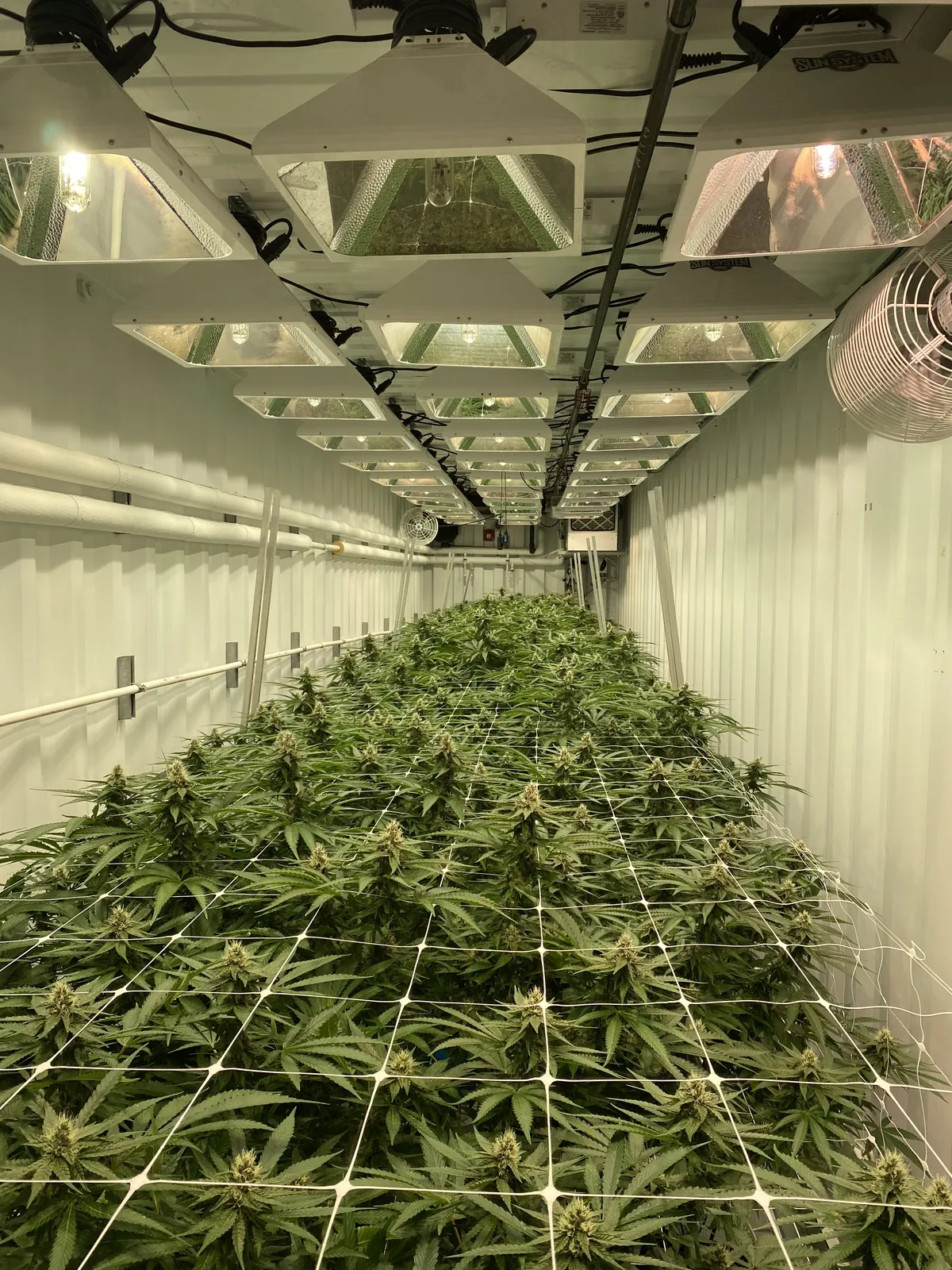
Buy a Nevada license and you buy its building, so the job is often a retrofit. A full indoor build runs $150 to $500+ per square foot: $3 million to $10 million or more for a 20,000 sq ft Las Vegas cultivation building, and $750,000 to $2.5 million or more for a 5,000 sq ft production suite. Southern Nevada's summer heat makes cooling and dehumidification the system to size first. Nevada's average commercial electricity price was 9.21 cents per kWh in 2025, against 13.37 cents nationally (EIA Electric Power Annual Table 2.10). In unincorporated Clark County, a business license needs the CCB license plus zoning approval from the Department of Comprehensive Planning, and a special use permit may be required. Model it in a cannabis cultivation business plan.
Nevada specifics
Testing. Flower is tested for moisture, potency, terpenes, mycotoxins, heavy metals, pesticides and microbials. A failed lot or production run is destroyed unless the CCB approves remediation or a retest passes, so set the dry room target with margin; see our water activity targets for dry and cure.
Outdoor. Outdoor cultivation needs a State Department of Agriculture verification, with zoning and local approvals documented, before the CCB approves it.
Security and tracking. Beyond the camera specs, plan for portable drives holding seven days of footage, at least 5 minutes of battery backup, exterior lighting and an alarm that notifies law enforcement. Licensees tag cannabis and products in Metrc.
| Topic | Nevada rule | Design response |
|---|---|---|
| Hydrocarbon extraction | Butane, isobutane, propane or heptane at 99%+ purity in a professional-grade closed loop; spark-free, ventilated space; local fire and building codes | Classified extraction room with gas detection and exhaust (C1D1 room requirements) |
| CO2 and ethanol | Closed-loop CO2 with vessels rated 900 psi or more; food-grade ethanol, glycerin and propylene glycol | Solvent storage and recovery sized to volume (NFPA 30 solvent room design) |
| Solventless | Heat, screens, presses, steam distillation and ice water allowed | Rosin and wash room with cold storage (rosin press and solventless equipment) |
| Odor and visibility | Indoor grows not visible from outside; no strong odor clearly detectable outside | Carbon and pressure control by room (cannabis HVAC design) |
| Cameras | 1920 x 1080 at 15 fps on entrances, exits, vaults and point of sale; 24-hour recording kept 30 days | Cameras, storage and backup power on the room plan (room-by-room facility planning) |
| Testing | Moisture under 15%; yeast and mold under 10,000 CFU per gram; solvent extracts under 500 ppm residual solvents | Dry room and sanitation spec built to pass (cannabis microbial testing compliance) |
| Tracking | Metrc tags on cannabis and cannabis products | Weigh and tag stations on the equipment layout (design around the equipment list) |
What the same work did for an operator like you
What a Nevada applicant gets from the design desk.
- Facility review before you close. Rooms, extraction, cameras and Metrc points checked against the current NAC, with a retrofit budget from our cannabis facility design team (1M+ sq ft designed).
- Grow-room recovery. Cannabis cultivation consulting for running Nevada rooms; our room-scale work went from 23 to 80 pounds per room.
- Microbial control. Cannabis microbial mitigation built around 95%+ microbial pass rates.
- Margin work after a deal. Cannabis profitability consulting for groups combining licenses.
- Equipment out, equipment in. Sell cannabis equipment through our Las Vegas marketplace, or buy units already in Nevada.
Nevada questions
How do you open a dispensary in Nevada?
As of October 2026, you open a Nevada dispensary by buying an existing retail license or an ownership interest in one, since no application window is open. Each transfer needs a Board vote, about three months for a clean file, and Clark County is capped at 80 retail stores.
Where are Nevada's cannabis regulations now?
Nevada's cannabis regulations are in NAC Chapters 678A to 678D, under NRS Chapters 678A to 678D. The NCCR is now historical, with an NCCR to NAC index on the CCB laws page. R152-24, adopted June 18, 2026, still has to clear the Legislative Commission.
How much does a Nevada cannabis license cost?
NRS 678B.390 caps state fees at a $5,000 application fee, then $3,000 to issue and $1,000 to renew a cultivation or production license, or $20,000 and $5,000 for a retail store. The building costs more, at $150 to $500+ per square foot indoors, with the build running 3 to 6 months after permits.
Which extraction solvents does Nevada allow?
Nevada allows butane, isobutane, propane and heptane at 99% purity in a professional-grade closed loop, CO2 at 99% purity in vessels rated to 900 psi or more, and food-grade ethanol, glycerin and propylene glycol. Solventless methods such as presses and ice water, the basis of commercial bubble hash washing, are allowed.
What camera specs does the CCB require?
The CCB requires at least 1920 x 1080 at 15 frames per second on entrances, exits, vaults and point of sale, and 720 x 480 in other limited access areas, recording 24 hours a day with footage kept 30 calendar days.
Can I buy used extraction equipment in Las Vegas?
Yes. As of October 2026, Las Vegas-based Urth & Fyre lists a Delta Separations CUP 15, a Chemtech KDT-6 short path unit and an Eccentroid wiped film system located in Nevada. Commission any used unit before it runs product; the used extraction equipment buying guide lists the checks.
Where the Nevada rules on this page come from
- CCB Laws and Regulations, NRS and NAC chapters, NCCR to NAC index
- NRS Chapter 678B, fees, caps, siting, applications, transfers
- CCB press releases, timeline dates, 2020 to 2026
- CCB minutes, June 18, 2026, R152-24, NAC transition, transfers
- CCB minutes, March 19, 2026, Ayr Wellness sale to Arboretum
- CCB List of Licensees, September 1, 2026, retail store and lounge counts
- CCB Biennial Report 2025, license counts, transfer timing
- NCCR Regulation 9 (historical), extraction methods and solvents
- NCCR Regulation 6 (historical), security and tracking
- NCCR Regulation 11 (historical), testing and failed lots
Regulator: Nevada Cannabis Compliance Board. Last reviewed October 23, 2026.
 Record last reviewed May 26, 2026