New York cannabis licensing, facility design and equipment.
How to get a grow license in NY in October 2026: no general cultivator window is open, so the routes are a pending 2023 application, the nursery window that opens November 5, or an ownership change on an existing license. Each route ends in a building that has to meet New York's odor, energy and security rules.
Nursery window opens Nov 5, 2026 (first 50 applications); canopy expansions under review
Syncing and validating with
Where New York is today
New York's adult-use market is regulated by the Office of Cannabis Management (OCM) and the Cannabis Control Board. The general application window closed December 18, 2023, and OCM is still licensing that queue: 2,322 adult-use licenses as of the Board's August 6, 2026 meeting, including 275 cultivators, 574 processors and 328 microbusinesses, with 19 more approved September 3 and 14 more October 1. As of October 2026 the only new window is for certain nursery licenses, and OCM is reviewing canopy expansions against a projected 356,000 lb supply shortfall. Compare cannabis licensing in every state.
- March 31, 2021. The Marihuana Regulation and Taxation Act is signed.
- December 29, 2022. First legal adult-use sale, at Housing Works Cannabis Co in Manhattan.
- October 4, 2023. OCM opens the general adult-use application window.
- December 18, 2023. The window closes with nearly 7,000 applications received.
- March 5, 2026. Resolution 2026-19 directs OCM to process canopy expansion requests.
- July 2, 2026. OCM reports 49 canopy amendments approved, adding 1.51M sq ft.
- October 1, 2026. Resolution 2026-76 approves nursery application forms and a new window.
- November 5, 2026. The nursery window opens and closes once 50 applications are submitted.
How to get a New York cannabis license
- Check the window. As of October 2026 no general window is open. The one new route is the nursery window, opening November 5, 2026 and closing after 50 submissions. If you cannot wait, compare the New Jersey cannabis license process.
- Nursery applicants: register with Agriculture and Markets. A nursery needs an active Nursery Grower Certificate of Registration. Apply through New York Business Express; the $1,000 fee is returned if you land after the first 50.
- Pick the tier. Size the rooms to the canopy tier before you file.
- Control the site. Cultivators and processors need proof of premises control and a certificate of occupancy before operating.
- Existing cultivators: request a canopy change. OCM reviews at least 12 months of cultivation history. A tier change is a $250 amendment plus the prorated license fee difference.
- Buying in. OCM says licenses are not transferable except in limited circumstances; ownership changes are amendments, $100 for 49% or less and $500 for a majority.
- Split by license type. Dispensary-only applicants wait for a retail window and test sites and margins with cannabis financial modeling. Cultivation, processing and nursery applicants start with new license facility planning, since the room program drives the tier and the sign-offs.
What the state issues, and what each one needs built
Most applications cost $1,000; Social and Economic Equity applicants pay 50% less on application and license fees.
- Cultivator (9 NYCRR 120.3): Tier 1 up to 5,000 sq ft of canopy, Tier 2 up to 12,500, Tier 3 up to 25,000, Tier 4 up to 50,000, Tier 5 up to 100,000. Indoor license fees run from $1,750 plus $450 per 500 sq ft at Tier 1 to $100,000 plus $2,000 per 500 sq ft over 50,000 sq ft at Tier 5.
- Processor, per premises: $7,000 with extraction; $2,000 for infusing and packaging; $2,000 for packaging and branding only, or $500 for Tier 1 and 2 cultivators.
- Microbusiness: $4,500, with canopy up to 3,500 sq ft indoor, 5,000 mixed light or 10,000 outdoor.
- Nursery: $750 outdoor up to 100,000 sq ft, $1,000 mixed light up to 10,000 sq ft, $2,000 for other nurseries up to 10,000 sq ft.
- Retail dispensary: $7,000 per premises, with no more than three per owner, passive investors aside.
- Ownership: a cultivator may add one processor, one distributor and a nursery license, but no retail interest.
What a New York facility costs to design and build.
Price a New York build from the canopy. A Tier 2 indoor license at its 12,500 sq ft cap comes to $1.9M to $6.3M+ at $150 to $500+ per sq ft on canopy alone, before drying, processing and mechanical space. A 3,500 sq ft indoor microbusiness grow comes to $525,000 to $1.75M+. The build runs 3 to 6 months after permits. Phase purchases with cannabis equipment financing.
New York's average commercial electricity price was 20.97 cents per kWh in 2025, well above the 13.37-cent U.S. average (EIA Electric Power Annual, Table 2.10), so fixture efficacy and heat recovery show up directly in operating cost.
Local permitting: under Cannabis Law section 131, municipalities could opt out only of retail dispensaries and on-site consumption, by December 31, 2021, and their time, place and manner rules reach only those sites. The building official still issues the certificate of occupancy.
New York specifics
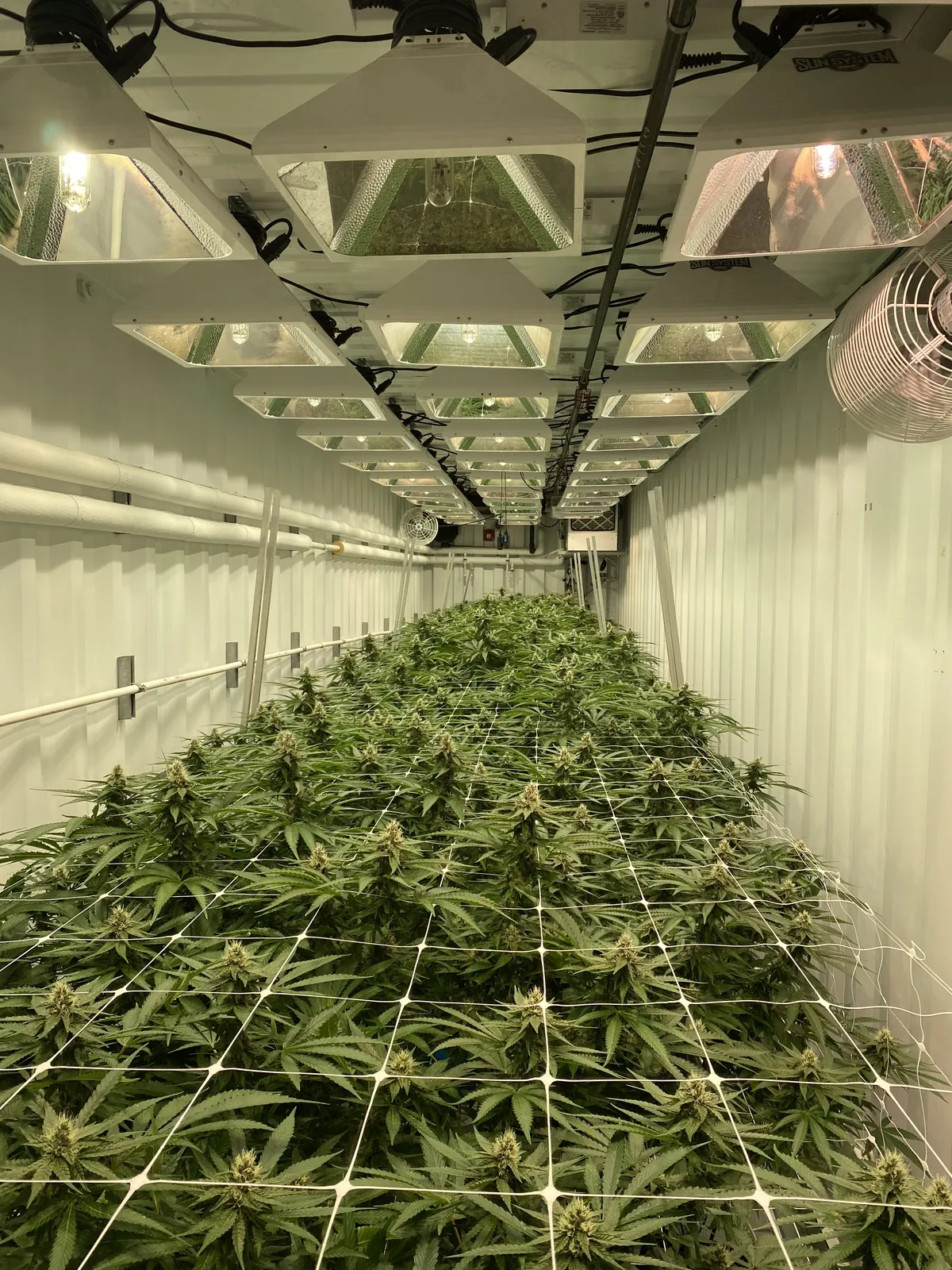
Indoor and mixed-light canopy, nursery, processing and storage areas need activated carbon, vapor-phase or other OCM-approved odor control. Every licensee needs an interval meter, and every licensee authorized to cultivate owed a PowerScore resource report by August 31, 2026. Cultivation water other than drip or subsurface irrigation must meet the coliform levels of 10 NYCRR Subpart 5-1.
Every product is tested for cannabinoids, pesticides, metals, mycotoxins, microbials, terpenes, aerobic bacteria and yeast and mold; concentrates add residual solvents. Build microbial testing compliance into the layout. Security means cameras in all areas with 60-day retention, a central-station alarm, 8 hours of backup power and an 8 ft fence around outdoor canopy. Tracking runs on Metrc.
| Topic | New York rule | Design response |
|---|---|---|
| Hydrocarbon extraction | Butane or propane at 99%+ in a commercial closed loop; PE or architect letter, fire marshal letter and certificate of occupancy first | C1D1 room and sign-offs in the MEP set |
| CO2 and ethanol | CO2 at 99.5%+ in a closed loop; compendial-grade ethanol; GMP under 21 CFR 111 or 117 | Solvent rooms to NFPA 30 limits |
| Odor | Carbon, vapor-phase or approved control in indoor and mixed-light canopy, nursery, processing and storage areas | Carbon and exhaust by room in the cannabis HVAC design |
| Lighting | PPE of 2.2 µmol/J for Tiers 3 to 5; 1.7 for smaller tiers, microbusinesses and nurseries | Fixtures specced on the grow room equipment list |
| Dehumidification | Stand-alone units at 1.77 or 2.41 L/kWh, or heat recovery covering 75% of reheat | Grow-optimized dehumidifiers or heat recovery |
| Refrigerants and heat | 20-year GWP of 10 or less; no on-site fossil combustion at Tiers 3 to 5 indoor | Chiller-first design with heat pumps |
| Testing | Flower adds moisture, filth and water activity | Dry and cure rooms set to water activity targets |
What the same work did for an operator like you
What a New York applicant gets from the design desk.
- Nursery applicants: cannabis facility design for mother, clone and propagation rooms laid out to the lighting, odor and water rules.
- Applicants in the 2023 queue: a facility design package in 30 to 60 days: room program, equipment schedule and the MEP set behind the certificate of occupancy.
- Cultivators expanding canopy: cannabis cultivation consulting that documents the utilization and sales history OCM weighs, then plans the added rooms.
- Every licensee: New York cannabis compliance review of extraction sign-offs, energy reporting, security and Metrc tag points.
New York questions
How do I open a dispensary in New York?
You cannot apply for a new retail dispensary license as of October 2026: the general window closed December 18, 2023 and no new retail window has been announced. Current rules set a $1,000 application fee, a $7,000 license fee, and a site at least 500 ft from a school on the same street and 200 ft from a house of worship.
How do I get a grow license in NY?
Not through a new cultivator application: no general window has opened since December 18, 2023. The paths are a pending 2023 application, the nursery window from November 5, 2026 (first 50 submissions), or an ownership change on an existing license, filed as an OCM amendment.
How much does a New York cannabis license cost?
Most applications cost $1,000, half for Social and Economic Equity applicants. License fees are $750 to $2,000 for a nursery, $4,500 for a microbusiness, $7,000 for a retail dispensary or an extraction processor, and $1,750 plus $450 per 500 sq ft for a Tier 1 indoor cultivator.
Is hydrocarbon extraction allowed in New York?
Yes, with butane or propane at 99% purity or better in a commercial closed-loop system that recovers the solvent, after OCM receives the PE or architect, fire marshal and occupancy documents. Plan the electrical around NFPA 496 purged and pressurized panels.
Can I expand my canopy in New York?
Yes, if you are an operating cultivator with at least 12 months of cultivation history, which OCM reviews under Resolution 2026-19. A tier change is a $250 amendment plus the prorated license fee difference.
What lighting and refrigerant rules apply to New York grows?
Lighting must reach 2.2 µmol/J at the lamp for Tiers 3 to 5 by the first renewal, or 1.7 for smaller tiers, microbusinesses and nurseries by the second. Refrigerants need a 20-year GWP of 10 or less unless OCM approves a leak and disposal plan; read low-GWP refrigerants and compliance.
Where the New York rules on this page come from
- OCM Board release, August 7, 2026, license totals, PowerScore deadline
- CCB Resolution 2026-76, nursery window and 50-application close
- CCB Resolution 2026-19, canopy expansion review and supply shortfall
- CCB meeting presentation, July 2, 2026, 2023 window and canopy amendments
- OCM adult-use license fees, application and license fees
- 9 NYCRR 120.3, canopy tiers and limits
- 9 NYCRR 123.6, extraction and GMP
- 9 NYCRR 125.1, odor, energy, HVAC and water
- 9 NYCRR 125.3, security
- Cannabis Law section 131, local opt-out and preemption
- EIA Electric Power Annual, Table 2.10 (2025), average commercial electricity price by state
Regulator: New York State Office of Cannabis Management. Last reviewed October 23, 2026.
 Record last reviewed May 26, 2026