A Quest dehumidifier for a commercial flower room is usually a 335, 506 or 746, and the number on the box overstates what you get at flower setpoints. Quest rates the 506 at 500 pints per day at 80°F and 60 percent RH, but 320 pints at 75°F and 50 percent. Size on the lower figure, then add one spare.
Which Quest dehumidifier models are in the current lineup?
The current Quest lineup runs from the 105 pint Compact 100 on a 120 volt outlet to the 730 pint Quest 746 on 480 volt three phase power. Quest's 2025 industrial dehumidifier catalog rates every unit at 80°F and 60 percent RH and lists an operating window of 56°F to 95°F.
The figures below come from that catalog and from Quest's individual product pages, which add the 75°F and 50 percent ratings that matter in a flower room.
- Quest Compact 100: 105 pints per day, 110 to 120 volts, 5.0 amps. A floor unit for small veg or mother rooms.
- Quest 155: 155 pints per day, 110 to 120 volts, 6.9 amps.
- Quest 205: 200 pints per day, 110 to 120 volts, 10 amps.
- Quest 225: 225 pints at 80°F and 60 percent, 130 pints at 75°F and 50 percent, 208 to 230 volts, 5.5 amps at 230 volts, 630 CFM, 130 lb, NEMA 6-15P plug.
- Quest 335: 345 pints at 80°F and 60 percent, 221 pints at 75°F and 50 percent, 7.6 amps at 230 volts, 900 CFM, 215 lb. Built in 208 to 230 volt and 277 volt versions.
- Quest 506: 500 pints at 80°F and 60 percent, 320 pints at 75°F and 50 percent, 9.2 pints per kWh, 9.9 amps at 230 volts, 1,150 CFM, 275 lb. Also built as a 277 volt model at 8.2 amps.
- Quest 746: 730 pints at 80°F and 60 percent, 480 pints at 75°F and 50 percent, 480 volt three phase, 4.9 amps, 1,650 CFM, 300 lb, hardwired.
- Quest Hi-E Dry 195 and Hi-E Dry 140: portable 120 volt units for dry rooms, temporary setups and backup.
The 225, 335, 506 and 746 pages list R454B refrigerant, and the catalog says the lineup is engineered and assembled in Madison, Wisconsin. Quest also sells the F10 Air Mover, a 1,015 CFM fan on 120 volts, which is useful for pushing dry air into dead corners under a canopy.
How do you size a Quest dehumidifier for a grow room?
Size a Quest dehumidifier on the water your plants put into the air each day, divided by the unit's capacity at the temperature and humidity you actually hold. That second number is the one most rooms get wrong. A 506 drops from 500 to 320 pints when the room moves from 80°F and 60 percent to 75°F and 50 percent.
Here is the order of operations we use on a flower room:
- Measure water in. Take the gallons irrigated per day at peak flower and subtract what leaves as runoff. Treat the rest as moisture load. Plants keep a small fraction, and ignoring it gives you margin.
- Convert to pints. One gallon is 8 pints, so 80 gallons a day is 640 pints a day.
- Pick the rating at your setpoint. Use the 75°F and 50 percent figure for late flower. At that condition the 225 removes 130 pints, the 335 removes 221, the 506 removes 320 and the 746 removes 480.
- Divide and round up. 640 pints needs two 506 units at 75°F and 50 percent, or two 746 units with headroom.
- Add one spare. A compressor failure on day 50 should not decide the crop. We would not design a flower room without N plus 1.
Lights off is the other check. Room temperature falls, relative humidity climbs and the units lose capacity as the air cools. If your night setpoint drops toward 65°F, ask Quest for capacity at that point, and remember the 56°F floor on the operating window.
How much heat does a Quest dehumidifier add to the room?
Every Quest dehumidifier adds its full heat of condensation plus motor heat to the room, and that load belongs in the cooling design. At 80°F and 60 percent, Quest lists the 225 at 14,400 BTU per hour, the 335 at 21,500, the 506 at 30,500 and the 746 at 45,700.
Three 506 units add 91,500 BTU per hour, which is about 7.6 tons of cooling at 12,000 BTU per ton. The cannabis HVAC design guide walks through stacking lighting, dehumidification and sensible loads into one tonnage number.
This is also why the 746 is worth pricing on large rooms. On the Quest 746 480V spec page, one unit removes 730 pints at 80°F and 60 percent for 45,700 BTU. Two 335 units remove 690 pints for 43,000 BTU and take two circuits and two hanging points instead of one.
Should a Quest unit hang overhead or sit on the floor?
Hang the 225, 335, 506 and 746 overhead when bench space is tight, and set them on the floor only when you can raise them high enough for the drain trap. All four mount freestanding or on 3/8 inch threaded rod, and each drains through a 3/4 inch threaded NPT port that needs a P trap.
Plan rigging on the actual weights: 130 lb for the 225, 215 lb for the 335, 275 lb for the 506 and 300 lb for the 746. Install day goes faster when the rod, unistrut and drain line are in place before the units arrive. Without a gravity drain below the unit, budget a condensate pump.
The Compact 100 and the Hi-E Dry units are floor units. They make sense in drying rooms and as backup, less so as the primary dehumidification in a production flower room.
Which voltage should you choose for a Quest dehumidifier?
Choose the voltage your lighting panels already serve, because dehumidifier circuits are usually added late and fight for panel space. On the Quest 335 208/230V page, the unit ships with a NEMA 6-15P cord at 8.4 amps at 208 volts.
- 120 volts: Compact 100, 155, 205 and the Hi-E Dry units. Fine for small rooms, expensive in circuits at scale.
- 208 to 230 volts: 225 on a 15 amp breaker, 335 on NEMA 6-15P, and 506 on NEMA 6-20P.
- 277 volts: 335 and 506 versions. The 277 volt 506 ships with a NEMA L7-20P cord, which suits rooms already wired for 277 volt lighting.
- 480 volts three phase: 746 only, hardwired.
Quest vs Anden: how do the 506 and A710V3 compare?
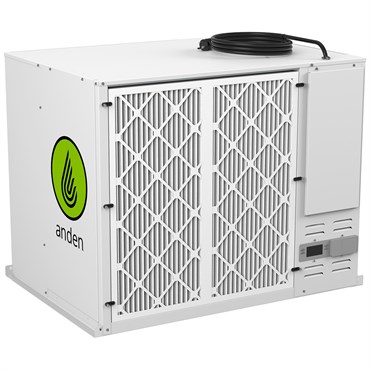
The Quest 506 uses less power per pint, and the Anden A710V3 removes more water per unit. On the two spec sheets, both rated at 80°F and 60 percent, the 506 removes 500 pints at 9.2 pints per kWh and the A710V3 removes 710 pints at 6.35 pints per kWh.
- Capacity at 80°F and 60 percent: Quest 506, 500 pints per day. Anden A710V3, 710 pints per day.
- Power: Quest 506, 2,250 watts. Anden A710V3, 4,820 watts.
- Electrical: Quest 506, 9.9 amps at 230 volts on NEMA 6-20P. Anden A710V3, 277 volts, 17.4 amps, 30 amp breaker, NEMA L7-30P.
- Airflow: Quest 506, 1,150 CFM. Anden A710V3, 1,760 CFM.
- Weight: Quest 506, 275 lb. Anden A710V3, 360 lb.
- Refrigerant: Quest 506, R454B. Anden A710V3, R410A on its 2020 spec sheet.
- Operating range: Quest, 56°F to 95°F. Anden, 60°F and 40 percent to 85°F and 80 percent.
The math on a room needing about 1,400 pints at 80°F and 60 percent: three 506 units draw 6,750 watts, and two A710V3 units draw 9,640 watts. The Anden saves a hanging point and a circuit. The Quest saves about 2.9 kW around the clock, plus the cooling to remove it. Anden publishes this sheet at one rating point, so ask for 75°F and 50 percent capacity before you compare at flower setpoints.
We recently sold an Anden A710V3 dehumidifier for $6,500, and the listing now shows Sold. If you want the Anden side of the comparison in more depth, read what a 710 pint dehumidifier does to a flower room, and our take on grow optimized versus industrial dehumidifiers. For the full Quest lineup history and buyer notes, see the Quest grow room dehumidifiers page.
Dehumidification, cooling and lighting have to be sized as one plan. Our cannabis facility design service sets unit counts, circuits and hanging points before the room is framed.
Quest dehumidifier FAQ
How many pints does a Quest 225 remove at 75°F?
The Quest 225 removes 130 pints per day at 75°F and 50 percent RH, against 225 pints at 80°F and 60 percent. Efficiency falls from 7.6 to 4.7 pints per kWh at the lower condition. It runs on 208 to 230 volts at 5.5 amps at 230 volts, so it fits veg rooms and small flower rooms better than production canopy.
What is the difference between the Quest 335 and the Quest 506?
The 506 removes 320 pints per day at 75°F and 50 percent, and the 335 removes 221. The 506 moves 1,150 CFM against 900, weighs 275 lb against 215, and takes 18 by 20 inch filters while the 335 takes 20 by 22. Both come in 208 to 230 volt and 277 volt versions.
Do Quest dehumidifiers need a condensate pump?
Only when you can't drain by gravity. Quest units drain through a 3/4 inch threaded NPT port into a P trap, so an overhead unit above a floor drain needs nothing more than a sloped line. A floor mounted unit with no drain nearby needs to sit high enough for the trap or feed a condensate pump.
Which Quest models are best for drying rooms?
The portable Hi-E Dry 195 and Hi-E Dry 140 suit drying rooms and short term moisture control because they roll in on 120 volts with no hard install. Check the room temperature first. Quest rates its units down to 56°F, so a dry room held near 60°F sits close to the bottom of that window.
Send your room size, setpoints, daily irrigation volume and available voltage through our equipment request form, and we will quote the Quest units that fit with lead time. For one model in detail, read our Quest 506 specs and used buying checks.

Founder of Urth & Fyre. 1M+ square feet of cannabis facilities designed and optimized. Every answer on this site is his.
About Trevor →