Delaware cannabis licensing, facility design and equipment.
With no application window open as of October 2026, the practical route to a Delaware cultivation license is buying into an existing one, with the Marijuana Commissioner's approval before closing. Lottery winners hold conditional licenses with 18 months to open, and indoor canopy tops out at 12,500 sq ft.
Adult-use sales since Aug 1, 2025; conditional licensees have 18 months to open; transfers need OMC approval
Syncing and validating with
Where Delaware is today
The Delaware Office of the Marijuana Commissioner (OMC) licenses cultivation, manufacturing, retail and testing under 4 Del. C. Chapter 13. Its only adult-use window closed Sept 30, 2024, lotteries followed, and sales began Aug 1, 2025. Lottery winners get conditional licenses with 18 months to open, and existing licenses change hands only with the Commissioner's approval. Compare it with cannabis licensing in every state.
- Apr 27, 2023. The Marijuana Control Act (HB 2) becomes law without the Governor's signature; effective Aug 1, 2023.
- Jul 17, 2024. HB 408 creates conversion licenses for medical compassion centers.
- Aug 19 to Sept 30, 2024. The only adult-use application window draws 1,271 applications.
- Oct 24 and Dec 19, 2024. License lotteries; the second covers open retail licenses.
- Aug 1, 2025. Adult-use sales begin.
- Jun 24, 2026. HB 271 limits added spacing rules to retail licenses.
- Jul 1, 2026. SB 75 passes over the Governor's veto; counties may not prohibit indoor, fully enclosed cultivation in agricultural or industrial zones.
- Jul 23, 2026. HB 373 creates the infused beverage endorsement.
How to get a Delaware cannabis license
- Check the window. As of October 2026 the OMC is not accepting applications. The Commissioner may open more licenses and must announce a window at least 10 business days ahead, so keep entity, capital and site ready.
- Or buy into a license. No transfer or ownership change takes effect until the Commissioner approves it, and a change of more than 10% costs $5,000 or 15% of the deal value, whichever is higher. Line up financing for the purchase and the build early.
- Diligence the license. Check its status, 18-month clock, tier, county assignment and social equity status.
- Lock the site. Going active requires legal control of the site, an OMC form showing local zoning, fire and building code compliance, and a full inspection. Plan rooms with our room-by-room facility design guide.
- File the conversion package. Final safety, security, diversion and operations plans need approval, plus a labor peace attestation and background checks.
- Pick your path. Dispensary-only buyers work mostly through retail spacing and ownership filings: start with Delaware cannabis compliance. Cultivation and manufacturing (processing) buyers carry the build risk on the 18-month clock: start with new license facility planning.
What the state issues, and what each one needs built
The OMC licenses cultivation, product manufacturing (often searched as processing), retail, testing and microbusinesses. The first round set 125 conditional licenses: 60 cultivation, 30 manufacturing, 30 retail and 5 testing.
- Cultivation, fee every two years: Tier 1 up to 2,500 sq ft indoor, $2,500; Tier 2 to 7,500 sq ft, $5,000; Tier 3 to 10,000 sq ft, $7,500; Tier 4 to 12,500 sq ft, $10,000. Outdoor tiers run to 7.5 acres. Social equity and microbusiness cultivators pay 40% of the open fee.
- Tier changes: one tier up per renewal with an updated safety, security and diversion plan. The Commissioner may add tiers above 12,500 sq ft if demand requires.
- Manufacturing: $10,000 every two years ($4,000 social equity or microbusiness), in an exclusive-use facility.
- Retail and testing: $10,000 every two years ($4,000 social equity); labs accredited to ISO/IEC 17025.
- Microbusiness: up to 10 employees and 2,500 sq ft of canopy, with no tier increases.
- Application fees: $5,000 open, $1,000 social equity, $3,000 microbusiness.
- Beverage endorsement: $1,500 to apply, $1,000 to renew.
- County limit: one establishment of each license type per county.
Next door, compare the Maryland cannabis license and New Jersey licensing and facility rules.
What a Delaware facility costs to design and build.
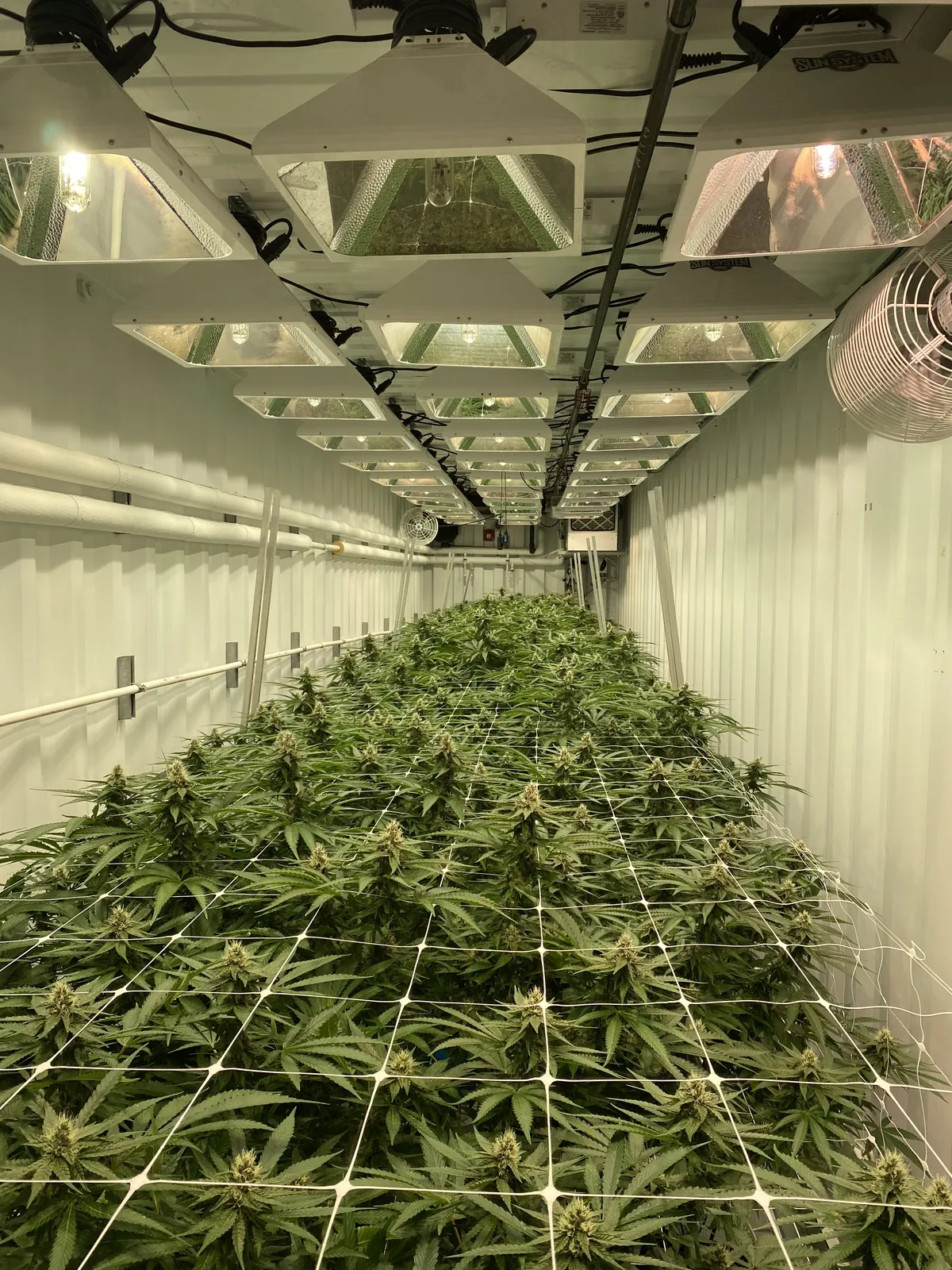
Delaware caps canopy, not buildings, and every shelf of a rack counts as canopy. If canopy takes about half the floor, a Tier 4 license at 12,500 sq ft needs about 25,000 sq ft of building: $3.75 million to $12.5 million or more at $150 to $500+ per sq ft. Tier 2 at 7,500 sq ft points to about 15,000 sq ft and $2.25 million to $7.5 million or more; a 2,500 sq ft microbusiness to about 5,000 sq ft and $750,000 to $2.5 million or more. Racking two levels shrinks the building, not the tier, which is why we design the facility around the equipment list.
Power: Delaware's average commercial electricity price was 12.68 cents per kWh in 2025 (EIA Electric Power Annual, Table 2.10), which drives lighting, cooling and dehumidification cost.
Permitting: since Jul 1, 2026, counties may not prohibit indoor, fully enclosed cultivation in agricultural or industrial zones, but towns can still ban marijuana establishments by ordinance. Dover allows cultivation in its M, IPM and A districts and manufacturing in M and IPM, 750 ft from residential zones, schools and similar uses.
Delaware specifics
Testing: residual solvents, toxins, harmful chemicals, mold and mildew, filth, microbials such as E. coli and salmonella, pesticides and label potency, at ISO/IEC 17025 labs.
Extraction: mechanical, nonvolatile solvent or approved closed loop; other methods need written Commissioner approval. The rules state that any form of alkane or petroleum hydrocarbon extraction is unauthorized in Delaware.
Security: cameras at 720p and 15 frames per second or better, routine footage kept 90 days and footage of significance up to 36 months, and alarm or video outages over 8 hours reported within 24 hours.
Codes and packaging: NFPA, IBC and IFC rules apply. Packaging is child-resistant and tamper-evident, and product is tracked seed to sale in the system the Commissioner specifies.
| Topic | Delaware rule | Design response |
|---|---|---|
| Canopy | Tiers to 12,500 sq ft; each shelf counts; racks max 24 ft | Shelf-by-shelf rack plan (grow room equipment list) |
| Extraction | No alkane or petroleum hydrocarbon extraction; approved closed loop | Closed-loop ethanol or solventless line (extraction equipment guide) |
| Solvent rooms | Closed loop approved by the local fire code official; no open flame nearby | Ethanol room drawn for the fire official (NFPA 30 solvent room design) |
| Manufacturing | Exclusive use; vented, with temperature and humidity control | Room-by-room air plan (cannabis HVAC design) |
| Testing | Mold, mildew, E. coli, salmonella, pesticides, residual solvents | Microbial protocol in the design (microbial testing compliance) |
| Packaging | Cultivation batches no larger than 10 lb; child-resistant | Weigh and tag stations sized to 10 lb lots (NTEP checkweighing) |
| Beverages | HB 373 endorsement; 10 mg THC per serving | Beverage and edible line (edibles equipment guide) |
What the same work did for an operator like you
What a Delaware applicant gets from the design desk.
- Pre-closing due diligence on a license you are buying: site, zoning, county and code path, from our cannabis facility design team
- A facility design package built for the OMC inspection in 30 to 60 days: room program, shelf-by-shelf rack plan, cameras and backup power
- A cannabis financial modeling build of the deal: price, the ownership-change fee, build cost and ramp
- Cannabis cultivation consulting for active licensees getting more yield from a capped tier
Delaware questions
Can I buy a Delaware dispensary license that is for sale?
Yes, if the Marijuana Commissioner approves the buyer first. No change in ownership, officers, financial interest or lease may be implemented until it is reported and approved, and inventory and payment pass directly between buyer and seller.
What should I check before buying a Delaware cultivation license for sale?
Check status, clock, tier, county and social equity. Ask whether the license is conditional or active and when its 18 months started. A social equity license cannot go to a non-qualifying buyer until 3 years after the active social equity license was awarded. The statute and rules set no separate transfer rule for an issued conditional license, so get the OMC's answer in writing.
What does a change of ownership cost in Delaware?
A change of more than 10% in ownership or financial interest costs $5,000 or 15% of the transaction value, whichever is higher: $300,000 on a $2 million deal. New owners also file an application, financial statements and the sale agreement.
How long does a Delaware conditional licensee have to open?
A conditional licensee has 18 months from the grant date, extendable for good-faith efforts; otherwise the license is rescinded. The OMC reported issuing at least 79 conditional licenses by Sept 2, 2025, so many deadlines fall in 2026 and 2027. Design takes 30 to 60 days and the build 3 to 6 months after permits; site control and permits use the rest.
What is the maximum cultivation canopy in Delaware?
The maximum is 12,500 sq ft indoor or 7.5 acres outdoor, unless the Commissioner adds tiers, which the law has allowed since Aug 1, 2025. Every shelf counts, and racks top out at 24 ft.
Is the OMC taking new cannabis license applications?
No. As of October 2026 the OMC's licensing page says it is no longer accepting applications.
Where the Delaware rules on this page come from
- 4 Del. C. ch. 13, subch. III, tiers, fees, license numbers, conditional licenses, testing
- 4 Del. C. ch. 13, subch. IV, local control and SB 75 county limits
- 4 Del. C. ch. 13, subch. VI and subch. VII, transfers and ownership changes
- 4 DE Admin. Code 5001 and the June 2026 final order, 18-month period, extraction, security, packaging
- OMC Licensing Cost, fees by type and tier
- OMC ownership and control guidance (Mar 3, 2026), transfer process
- OMC 2024 Annual Report, 2024 window and lotteries
- Delaware News, Aug 1, 2025, start of adult-use sales
- OMC Infused Beverages, beverage endorsement
- OMC Legislative Updates (Jul 16, 2026), HB 271 and SB 75
- EIA Electric Power Annual, Table 2.10 (2025), average commercial electricity price by state
Regulator: Delaware Office of the Marijuana Commissioner. Last reviewed October 23, 2026.
 Record last reviewed May 26, 2026