Maine cannabis licensing, facility design and equipment.
A Maine cannabis license takes three steps: the Office of Cannabis Policy issues a conditional license, the town authorizes, then the license goes active. Cultivation runs in Tiers 1 to 4 up to 20,000 sq ft of canopy, with 343 adult use licenses active at the end of 2025. Taxes changed Jan. 1, 2026; outdoor rules July 29, 2026.
343 adult use licenses active end of 2025; 52 more conditional; outdoor cultivation law live July 29, 2026
Syncing and validating with
Where Maine is today
Maine is an operating adult use and medical market run by the Office of Cannabis Policy (OCP). Adult use licensing takes three steps: conditional license, local authorization, active license. OCP counted 343 active adult use licenses on Dec. 31, 2025 (78 cultivation, 81 manufacturing, 180 stores, 4 labs) plus 52 conditional licenses, and 279,197 sq ft of approved canopy running at 66.5% utilization. The medical side had 1,539 caregivers and 90 dispensary registrations.
Two 2026 changes matter for a build: the excise tax dropped from $335 to $223 per pound and the sales tax rose to 14% on Jan. 1, 2026, and P.L. 2025 ch. 514 added an outdoor cultivation category effective July 29, 2026. Compare Maine with cannabis licensing in every state.
- 2018. P.L. 2017 ch. 409 sets the adult use licensing framework and the Section 207 fee schedule.
- Dec. 31, 2025. 343 active adult use licenses; cultivation at 10 Tier 1, 34 Tier 2, 24 Tier 3, 9 Tier 4 and 1 nursery; 2025 store sales $246.4 million.
- Jan. 1, 2026. P.L. 2025 ch. 388 cuts the cultivation excise tax from $335 to $223 per pound and raises the adult use sales tax from 10% to 14%.
- Jan. 11, 2026. P.L. 2025 ch. 512 (LD 1840) becomes law without signature, letting caregivers sell and deliver from their own property and trade shows.
- July 29, 2026. P.L. 2025 ch. 514 (LD 1897) takes effect: outdoor caregiver category up to 150 mature plants or 2,500 sq ft, and an outdoor-only option for adult use cultivators at renewal.
- Jan. 8, 2027. Deadline for OCP's medical research grant rules under P.L. 2025 ch. 757.
How to get a Maine cannabis license
- File for a conditional license. OCP reviews the application, fingerprints principals and issues individual identification cards ($50, plus $52 fingerprinting) to every principal and employee. A conditional licensee may not grow, make, test or sell.
- Win local authorization. The municipality has 90 days to respond, with one 90 day extension. Only 22 of 52 conditional licensees had it at the end of 2025, so pick an opted-in town before you sign a lease.
- Size the tier to the plan. Tier 3 (7,000 sq ft) at $10,000 a year indoors versus Tier 4 (20,000 sq ft) at $30,000. Test it in a cultivation business plan against 2025's 66.5% statewide canopy utilization and $6.62 per gram.
- Go active. Pay the license fee, pass OCP's inspection and start tagging in the state tracking system; 59% of cultivators were on batch tags by December 2025.
- Pick your starting point. Dispensary plans: the $2,500 store license is cheap, so the fight is site and margin; model it with cannabis financial modeling. Cultivation and processing plans: start new license facility planning so tier, canopy and mechanical plant are fixed before conditional approval.
What the state issues, and what each one needs built
- Cultivation facility, Tiers 1 to 4 and nursery. Tier 1: 30 mature plants or 500 sq ft of canopy; Tier 2: 2,000 sq ft; Tier 3: 7,000 sq ft; Tier 4: 20,000 sq ft with increases at renewal no more than once every two years; nursery 1,000 sq ft. Annual indoor fee up to $500 (Tier 1 canopy), $3,000 (Tier 2), $10,000 (Tier 3), $30,000 (Tier 4), $350 (nursery); outdoor rates are half. Application $60 (nursery) to $500.
- Products manufacturing facility. Extraction and infused products; $250 application, up to $2,500 a year; 81 active.
- Cannabis store. Retail; $250 application, up to $2,500 a year; 180 active, the largest license class.
- Testing facility and sample collector. $250 and up to $1,000 for a lab (4 active); $100 and up to $250 for a sample collector.
- Medical registrations. Caregiver $240 to $1,500 a year (30 mature plants or 500 sq ft indoors; 150 plants or 2,500 sq ft outdoors from July 29, 2026); dispensary $5,000; inherently hazardous substance manufacturing certificate $350.
What a Maine facility costs to design and build.
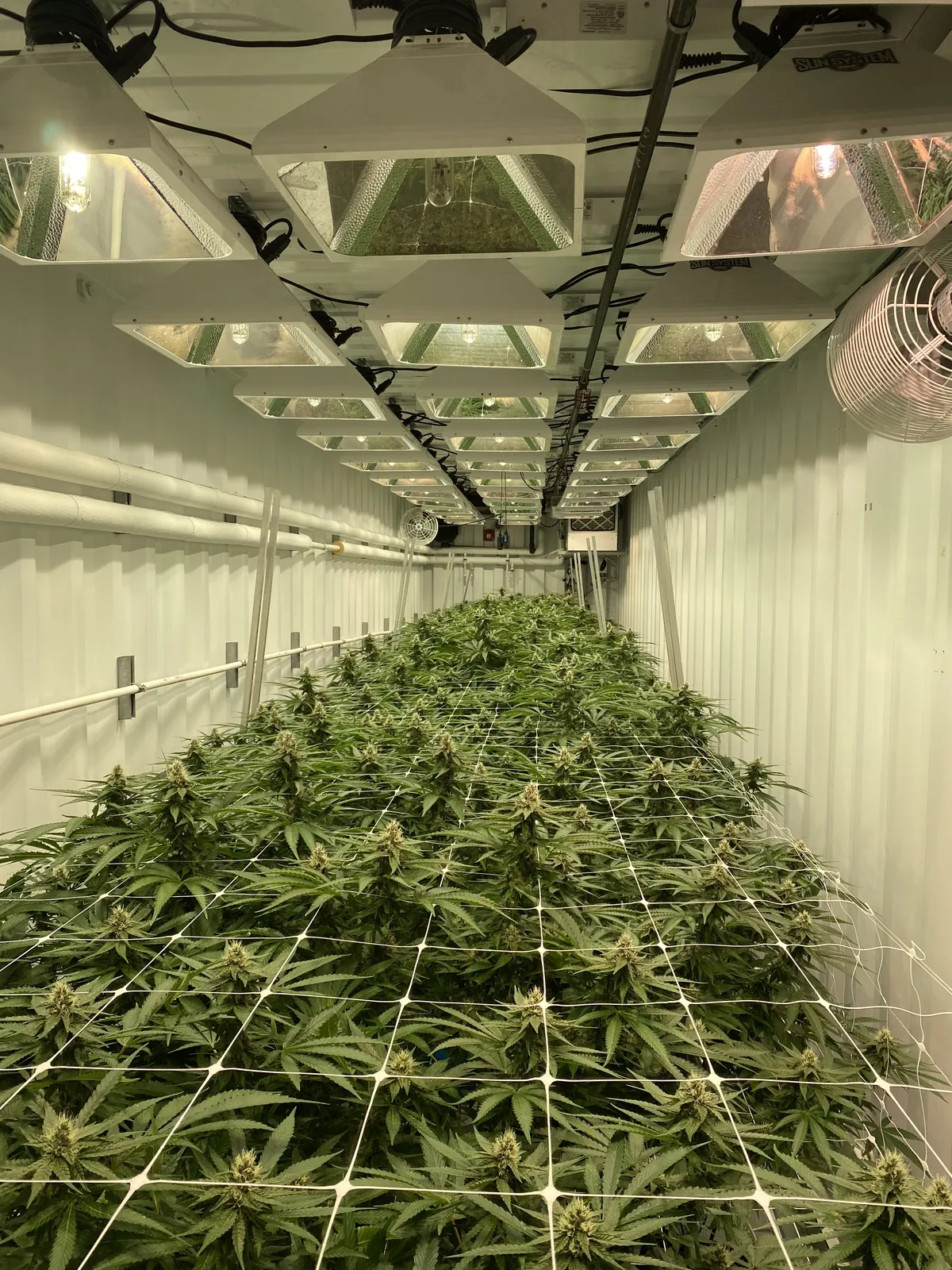
A Tier 3 indoor facility holds 7,000 sq ft of canopy inside a larger building; at $150 to $500+ per sq ft, a 14,000 sq ft building is $2.1 million to $7 million or more against a $10,000 annual license fee. Tier 4 at 20,000 sq ft roughly triples the canopy and the fee is $30,000. Design takes 30 to 60 days and construction 3 to 6 months after permits, with the conditional license and local authorization running in parallel.
Power is the Maine problem: commercial electricity averaged 20.86 cents per kWh in 2025 against a 13.37 cent U.S. average, per EIA Electric Power Annual, Table 2.10, up from 18.22 cents in 2024. That price is why the outdoor option and the $223 per pound excise matter to the model, and why heat recovery and dehumidification efficiency decide an indoor grow's margin through a long heating season. Siting is municipal: no active license without the town's authorization.
Maine specifics
Testing. Every adult use batch sold at retail is tested from a representative sample across eight categories: filth and foreign materials, dangerous molds, harmful microbes, THC potency, water activity, heavy metals, residual solvents and pesticides. 17,701 samples ran in 2025 with a 6.4% initial fail rate. Medical cannabis has no mandatory contaminant testing unless the label makes a claim.
Security. Every principal, contractor and employee carries an OCP identification card and principals pass a fingerprint check. Camera, alarm and access rules sit in OCP's adult use rules (18-691 C.M.R. ch. 5, 10, 20, 30 and 40); confirm retention periods with OCP before the camera schedule is drawn.
Tracking. Adult use licensees report into the Adult Use Cannabis Tracking System (P.L. 2021 ch. 628), with batch tagging rolling out through cultivation in 2025. The medical program had no tracking mandate in OCP's Feb. 2026 report, which recommends one.
Packaging and edibles. Medical solvent extraction needs an inherently hazardous substance manufacturing certificate ($350 a year); 22 were issued by the end of 2025. Adult use edible and packaging limits live in the same OCP rule set.
| Topic | Maine rule | Design response |
|---|---|---|
| Cultivation tiers | Tier 2 2,000 sq ft, Tier 3 7,000 sq ft, Tier 4 20,000 sq ft of canopy; Tier 4 increases at renewal no more than once every two years (28-B MRS 304) | Tiered rooms on NextGen Benching under Thrive Agritech LED, laid out with the HVAC design guide |
| Testing | Eight analyte categories including molds, microbes and water activity; 6.4% initial fail rate in 2025 | Dry rooms held by water activity with Anden dehumidifiers |
| Outdoor cultivation | Outdoor-only option at renewal from July 29, 2026; outdoor license fees half the indoor rate | Post-harvest drying and cure building sized for a single fall harvest, grow-optimized dehumidifiers over industrial units |
| Extraction | Products manufacturing license (adult use) or IHS certificate (medical) for solvent extraction | C1D1 room with a Lowtemp rosin press line as the solventless alternative |
What the same work did for an operator like you
What a Maine applicant gets from the design desk.
- A cannabis compliance review against OCP's adult use rules (18-691 C.M.R.) and the 2026 law changes before OCP inspection
- Cannabis facility design sized to the tier you can fill, from a 2,000 sq ft Tier 2 to a 20,000 sq ft Tier 4
- A cannabis facility design package in 30 to 60 days with a kWh per pound model for Maine power prices
- Margin review with cannabis profitability consulting and our equipment financing guide
Maine questions
How do I get a Maine cannabis license?
Apply to the Office of Cannabis Policy for a conditional license, get local authorization from the municipality (90 days plus one 90 day extension), then pay the license fee and pass inspection for an active license. 343 adult use licenses were active at the end of 2025, with 52 more conditional.
How do I open a dispensary in Maine?
Apply for a cannabis store license: $250 application and up to $2,500 a year, through the same three steps as every license. Maine had 180 active adult use stores at the end of 2025 selling $246.4 million, so the constraint is a town that has opted in and a lease that works at $6.62 per gram. For a larger Northeast market, see New York.
What are Maine's cultivation license tiers?
Tier 1 is 30 mature plants or 500 sq ft of canopy; Tier 2 is 2,000 sq ft; Tier 3 is 7,000 sq ft; Tier 4 is 20,000 sq ft with increases allowed at renewal no more than once every two years; a nursery is 1,000 sq ft. In 2025 Maine had 34 Tier 2, 24 Tier 3 and 9 Tier 4 licenses using 66.5% of approved canopy.
How much does a Maine adult use license cost?
Cultivation runs from $500 a year (Tier 1 canopy, indoor) to $30,000 (Tier 4 indoor), with outdoor at half those rates and applications of $100 to $500. Manufacturing and store licenses are $250 to apply and up to $2,500 a year; labs up to $1,000. Every worker needs a $50 identification card. Fees are not refundable.
What changed for Maine cannabis in 2026?
On Jan. 1, 2026 the excise tax fell from $335 to $223 per pound and the sales tax rose from 10% to 14%. On Jan. 11, 2026 caregivers gained new sales and delivery rights (P.L. 2025 ch. 512). On July 29, 2026 outdoor cultivation got its own caregiver category and an adult use outdoor-only option (P.L. 2025 ch. 514).
Where the Maine rules on this page come from
- OCP Adult Use Cannabis Program 2025 Annual Report (Feb. 13, 2026), license counts by tier, canopy, sales, testing, tracking, tier sizes, 2026 tax change
- OCP Medical Use of Cannabis Program 2025 Annual Report (Feb. 13, 2026), caregivers, dispensaries, IHS certificates, no mandatory testing or tracking, LD 1847
- 28-B MRS Section 207, application and license fees by license type and tier
- OCP FAQ, three-step process, local authorization timing, identification cards, fee schedule, medical caregiver limits
- OCP memo on outdoor cultivation (July 27, 2026), P.L. 2025 ch. 514 effective July 29, 2026
- Maine Legislature summary of LD 1840, P.L. 2025 ch. 512, law without signature Jan. 11, 2026
- EIA Electric Power Annual, Table 2.10 (2025), average commercial electricity price by state
Regulator: Maine Office of Cannabis Policy. Last reviewed November 7, 2026.
 Record last reviewed