Ohio cannabis licensing, facility design and equipment.
How to open a dispensary in Ohio: you cannot apply today. The Division of Cannabis Control accepts no new cultivator, processor or dispensary applications, and S.B. 56 capped operating dispensaries at 400 statewide. As of Nov. 2026, 233 dispensaries hold dual-use certificates of operation and 47 provisional licenses are building out, so the route in is a license purchase.
No new license applications as of Nov. 2026; 233 dispensaries open Oct. 26, 2026 under a 400 store cap
Syncing and validating with
Where Ohio is today
Ohio is an operating adult use and medical market run by the Ohio Department of Commerce, Division of Cannabis Control (DCC). Adult use sales began Aug. 6, 2024 through dual-use licenses held by medical operators, and S.B. 56 (effective March 20, 2026) repealed Chapter 3780 and moved every license into R.C. Chapter 3796.
DCC lists 233 operating dispensaries, 47 provisional licenses, 23 Level I and 14 Level II cultivators, 45 processors and 6 labs as of Oct. 26, 2026. No new applications are being accepted and the statute caps operating dispensaries at 400, so new entrants buy licenses. Compare cannabis licensing in every state.
- Nov. 7, 2023. Voters pass Issue 2; Chapter 3780 takes effect Dec. 7, 2023.
- June 7, 2024. DCC opens dual-use conversion and 10(B) dispensary applications to medical licensees.
- Aug. 6, 2024. First dual-use certificates of operation; adult use sales begin.
- Dec. 19, 2025. Gov. DeWine signs S.B. 56.
- March 20, 2026. S.B. 56 takes effect: Chapter 3780 repealed, 400 dispensary cap, 70% extract cap, Level III and new 10(B) licenses eliminated, Chapter 3780, which housed the social equity and jobs program, repealed.
- Oct. 5, 2026. OAC 1301:18-4-06 package limits take effect: 10 mg per adult use edible portion, 100 mg per package, 90% product ceiling.
- Nov. 2, 2026. OAC 1301:18-6-06 manufacturing rule takes effect: 99% solvent purity and closed-loop systems.
- Nov. 12, 2026. Federal hemp definition changes take effect; S.B. 56 states the General Assembly's intent to review hemp beverage rules afterward.
How to get a Ohio cannabis license
- Confirm nothing is open. DCC's applications page lists only dual-use and 10(B) filings, both reserved for existing medical licensees, and S.B. 56 ended new 10(B) issuance.
- Price an acquisition. With a 400 cap and 47 provisional licenses on an 18 month clock, licenses are the market. Ownership changes file under OAC 1301:18-3-06, capped at 8 dispensaries, 1 cultivator and 1 processor per person. Line up cannabis business financing before you bid.
- Clear local control and the 500 ft rule. A municipality or township may prohibit or limit operators (R.C. 3796.29). Every facility sits 500 ft from any school, church, public library, playground or park (R.C. 3796.30), measured from the parcel line (OAC 1301:18-3-01).
- Phase the canopy. Cultivators expand only after using all current canopy (OAC 1301:18-5-04), so write the cultivation business plan in stages.
- Design to the 2026 rulebook. GMP (OAC 1301:18-4-01), manufacturing (1301:18-6-06) and package limit (1301:18-4-06) rules all took effect in 2026, and major renovations need written DCC approval before work starts (1301:18-6-03). Design around the equipment list first.
- Pick your starting point. Dispensary plans: price the purchase and 18 month buildout with cannabis financial modeling and a compliance review of the site. Cultivation and processing plans: start new license facility planning so canopy, extraction and MEP meet OAC 1301:18.
What the state issues, and what each one needs built
- Level I cultivator. Up to 100,000 sq ft of canopy (R.C. 3796.18), licensed at 25,000 sq ft with expansion by approval; 23 licensed. Fees: $20,000 application, $180,000 certificate of operation, $200,000 annual renewal.
- Level II cultivator. Up to 15,000 sq ft, licensed at 3,000. 14 licensed. Fees: $2,000 application, $18,000 certificate, $20,000 annual renewal. S.B. 56 eliminated the 5,000 sq ft Level III license before any issued.
- Processor. 45 licensed, one per person. Fees: $10,000 application, $18,000 certificate, $50,000 annual renewal.
- Dispensary. 233 operating and 47 provisional under a 400 cap; up to 8 per person; one mile from another dispensary. Fees: $5,000 application, $70,000 certificate, $70,000 biennial renewal. Provisional holders must open within 18 months.
- Dual-use and 10(B). Dual-use added adult use to medical sites at no fee; 10(B) gave medical licensees 1 to 3 extra dispensaries each until S.B. 56 ended new issuance.
What a Ohio facility costs to design and build.
Size the program to the tier. Example: a 25,000 sq ft building for a Level II cultivator at its 15,000 sq ft canopy cap runs $3.75 million to $12.5 million or more at $150 to $500+ per sq ft. Design takes 30 to 60 days and the build 3 to 6 months after permits; a provisional dispensary's 18 month clock leaves no room for a redesign.
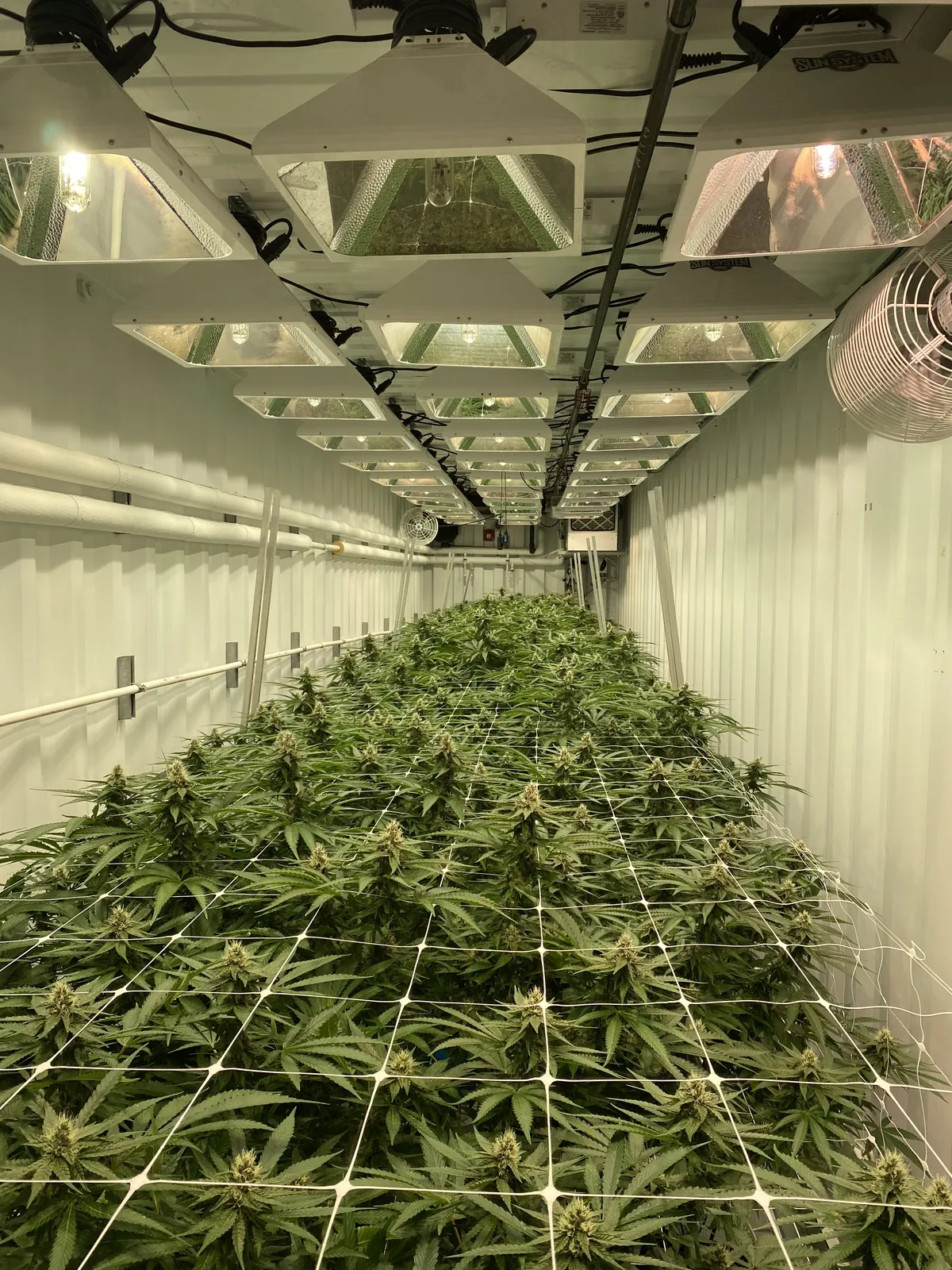
Power: Ohio's average commercial electricity price was 11.58 cents per kWh in 2025 against a 13.37 cent U.S. average, and industrial service averaged 8.39 cents, per EIA Electric Power Annual, Table 2.10. Humid summers put a heavy dehumidification load on sealed flower rooms. Specify grow-optimized dehumidifiers, with Quest units sourced on request, and model kWh per pound early.
Siting: a municipality or township may prohibit or limit operators (R.C. 3796.29), and every facility sits 500 ft from a school, church, public library, playground or park (R.C. 3796.30). Host communities receive 36% of the 10% excise tax (R.C. 3796.40), which gives a council a reason to say yes.
Ohio specifics
Testing. Every batch moves through Metrc lab test batches (DCC Lab Test Batch Guidance, Sept. 2026). Flower is tested for pesticides, four heavy metals, mycotoxins, microbials including Salmonella and STEC, cannabinoids, foreign matter, moisture and water activity; solvent products add residual solvents.
Odor. No odor-specific rule. OAC 1301:18-4-01 (Jan. 1, 2026) requires ventilation that minimizes dust, odors and vapors, and local zoning often adds more. Plan carbon filtration and negative pressure in flower, dry and trim rooms.
Security. OAC 1301:18-5-05 (cultivators), 1301:18-6-04 (processors) and 1301:18-8-05 (dispensaries): commercial alarm with silent duress, 24 hour motion-activated video at 15 frames per second, 45 day retention, monthly tests, repairs within 24 hours.
Tracking. Metrc is the state seed-to-sale system. OAC 1301:18-3-10 (Jan. 1, 2026) requires Metrc training before access; manifests, destruction and records run through it (OAC 1301:18-3-12 to 3-16).
Packaging and edibles. R.C. 3796.06 caps plant material at 35% THC and extracts at 70%; DCC's OAC 1301:18-4-06 (Oct. 5, 2026) sets a 90% product ceiling and caps adult use edibles at 10 mg per portion and 100 mg per package, beverages at 10 mg per container and flower at 1 oz per package. Labels carry the universal THC symbol (OAC 1301:18-4-20).
| Topic | Ohio rule | Design response |
|---|---|---|
| Cultivation canopy | Level I up to 100,000 sq ft, Level II up to 15,000 (R.C. 3796.18); expansion only after full use (OAC 1301:18-5-04) | HVAC designed per room with Anden dehumidifiers carried by Urth & Fyre |
| GMP and ventilation | OAC 1301:18-4-01: ventilation that minimizes dust, odors and vapors; potable water; pests excluded | Breeza fans and carbon filtration in a sealed grow room layout |
| Extraction | OAC 1301:18-6-06: closed-loop system; propane, n-butane, isobutane or heptane at 99% purity; spark-free ventilated room; fire and building codes (1301:18-6-03) | A C1D1 room in the MEP set with used Precision Extraction systems |
| Testing | Metrc lab test batches; microbials including Salmonella, STEC, yeast and mold; water activity | Microbial prevention in airflow and sanitation; potency checks with Orange Photonics |
| Edibles and packages | OAC 1301:18-4-06: 10 mg per adult use portion, 100 mg per package; 55 mg per medical portion; packages within 90% to 110% of target THC | Dosing line from the edibles equipment guide with NTEP checkweighing |
| Security | 15 fps video, 45 day retention, duress alarm (OAC 1301:18-5-05, 6-04, 8-05) | Camera and limited-access plan inside the facility design package |
What the same work did for an operator like you
What a Ohio applicant gets from the design desk.
- An Ohio cannabis compliance review against R.C. Chapter 3796 and OAC 1301:18 before you buy a license or request an expansion
- Cannabis facility design for Level I or Level II canopy, phased to the expansion rule
- A cannabis facility design package in 30 to 60 days: room program, MEP set, security layout and equipment schedule
- Extraction rooms specified from our cannabis extraction equipment guide to the closed-loop and 99% purity language in OAC 1301:18-6-06
Ohio questions
How do I open a dispensary in Ohio?
Buy a provisional or operating dispensary license, because DCC is not accepting new dispensary applications as of Nov. 2026 and the statute caps operating stores at 400. File the ownership change under OAC 1301:18-3-06, keep the site one mile from other dispensaries and 500 ft from protected uses, and open within 18 months of the provisional date.
Is Ohio accepting new cannabis license applications in 2026?
No. DCC's applications page lists only dual-use conversion and 10(B) filings, both limited to existing medical licensees, and S.B. 56 ended new 10(B) issuance on March 20, 2026. A new cultivator round depends on DCC's count under R.C. 3796.05(A). For a Midwest comparison, see Missouri cannabis licensing.
How much does a dispensary license cost in Ohio?
DCC charges $5,000 to apply, $70,000 for the certificate of operation and $70,000 every two years to renew. The larger number is the license purchase price in a capped market plus the buildout, which Urth & Fyre clients report at $150 to $500+ per sq ft.
How much is an Ohio cultivator license?
Level I: $20,000 to apply, $180,000 for the certificate of operation and $200,000 a year to renew, for up to 100,000 sq ft of canopy. Level II: $2,000, $18,000 and $20,000 a year for up to 15,000 sq ft. Both windows closed in 2017.
Can a city or township ban dispensaries in Ohio?
Yes. R.C. 3796.29 lets a municipal legislative authority or township trustees prohibit or limit cultivators, processors and dispensaries. Operators licensed before March 20, 2026 are protected unless the ordinance predates that date. Get zoning confirmed in writing before site control.
What does an Ohio extraction room need?
OAC 1301:18-6-06 (Nov. 2, 2026) requires a professional grade closed-loop system, 99% pure propane, n-butane, isobutane or heptane, a spark-free ventilated room and a Department of Agriculture inspection. OAC 1301:18-6-03 adds fire and building code compliance for solvents, so we draw the room to NFPA 30 for ethanol and lay out distillation before the MEP set.
Where the Ohio rules on this page come from
- Ohio LSC Final Analysis, S.B. 56, effective date, Chapter 3780 repeal, Level III and 10(B) changes
- R.C. 3796.05, 400 cap, 18 month clock, one mile spacing, ownership limits
- R.C. 3796.06, 35% and 70% THC caps
- R.C. 3796.18, Level I and Level II canopy
- R.C. 3796.29, local prohibition and limits
- R.C. 3796.30, 500 ft setback
- R.C. 3796.40, 10% excise tax, 36% host share
- DCC: Cultivators and Processors, counts, canopy, fees
- DCC: Dispensaries, fees, closed window
- DCC: Applications, dual-use and 10(B) eligibility
- DCC Update By The Numbers, Oct. 26, 2026, licensee and patient counts
- OAC 1301:18-4-06, package limits effective Oct. 5, 2026; rules 1301:18-4-01, 5-05, 6-06 and 8-05 at codes.ohio.gov
- EIA Electric Power Annual, Table 2.10 (2025), electricity price by state
Regulator: Ohio Department of Commerce, Division of Cannabis Control. Last reviewed November 7, 2026.
 Record last reviewed