California cannabis licensing, facility design and equipment.
How to open a dispensary in California: win local authorization, then apply to the Department of Cannabis Control for a Type 10 storefront or Type 9 delivery license. The market is open and consolidating as of Nov. 2026: provisional licenses ended Jan. 1, 2026, the excise tax is back at 15%, and 53% of cities and counties ban cannabis businesses.
Operating market; provisional licenses ended Jan. 1, 2026; excise tax back at 15% since Oct. 1, 2025
Syncing and validating with
Where California is today
California is an operating, consolidating market licensed by activity by the Department of Cannabis Control (DCC). DCC counted 7,912 annual and 376 provisional licenses in its March 1, 2026 budget report (FY 2024-25 data); provisional licensing closed Jan. 1, 2026 for all but certain equity retailers. Applications stay open, yet 284 of 540 cities and counties allow no cannabis business.
The excise tax hit 19% on July 1, 2025 and returned to 15% on Oct. 1, 2025 under AB 564. Re-equipping operators and used equipment buyers start with the rules below; compare cannabis licensing in every state.
- July 2021. DCC consolidates licensing under one department; rules sit in Title 4, Division 19.
- July 1, 2025. Excise tax rises from 15% to 19%.
- Oct. 1, 2025. AB 564 returns the rate to 15%.
- Jan. 1, 2026. Last day any provisional license is in effect, except certain equity retailers; 2025 Title 24 takes effect.
- June 4, 2026. DCC emergency rule lets dual A and M licensees split licenses after the DEA's April 28, 2026 Schedule III order.
- Oct. 1, 2026. New pesticide action levels take effect.
- Dec. 15, 2026. Hearing on the permanent A and M split rule.
How to get a California cannabis license
- Clear the local gate first. Only 256 of 540 cities and counties allow any cannabis business; 302 ban retail. DCC cannot approve a license that violates a local ordinance (BPC 26055), and premises sit 600 feet from schools (BPC 26054).
- Plan CEQA with the city or county. Every annual license is subject to CEQA; the local government is usually lead agency.
- Assemble the DCC application. Premises diagram (4 CCR 15006), proof of right to occupy, owner lists, a $5,000 surety bond per premises and CEQA evidence.
- Stand up Metrc. The account manager trains, gets credentials after licensure and orders UID tags, included in the annual fee.
- Pick your starting point. Dispensary plans: run cannabis financial modeling, then new license facility planning. Cultivation and processing plans: fit the cultivation business plan to the canopy tier, then begin cannabis facility design.
What the state issues, and what each one needs built
- Cultivation. By canopy: specialty cottage (to 500 sq ft indoor), specialty (to 5,000), small (5,001 to 10,000), medium (10,001 to 22,000), large (above 22,000). Annual fees $1,205 to $77,905.
- Manufacturing. Type 7 volatile solvent; Type 6 nonvolatile and mechanical; Type N infusion; Type P packaging; Type S shared-use. $2,000 to $75,000 a year by revenue.
- Distribution. Type 11 ($1,500 to $240,000); Type 13 transport-only ($200 to $1,000).
- Retail. Type 10 storefront, Type 9 delivery-only; $2,500 to $96,000 by revenue.
- Microbusiness (Type 12). Three of four activities at one site; cultivation capped at 10,000 sq ft.
- Testing laboratory and events. Separate licenses.
What a California facility costs to design and build.
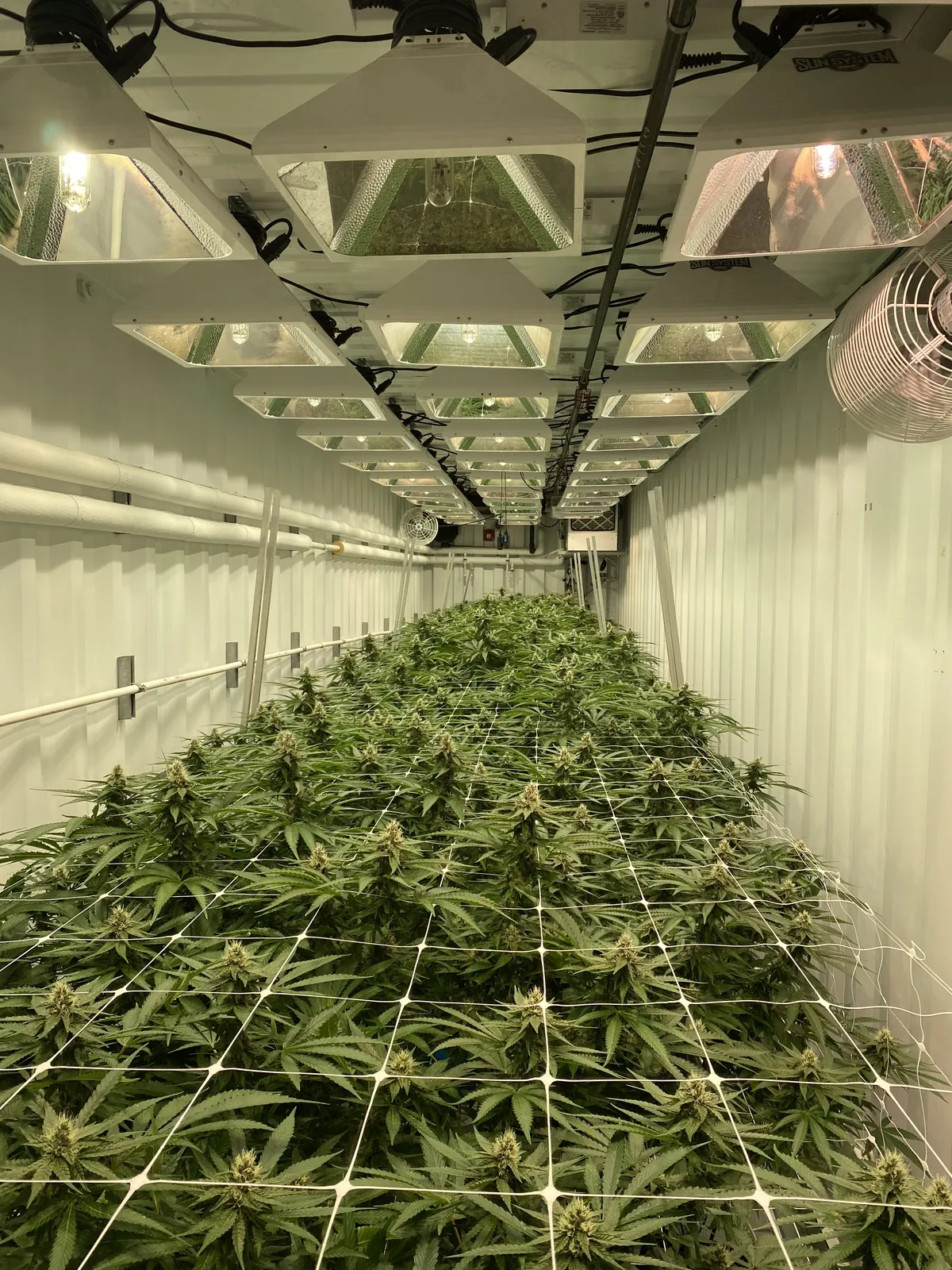
Small indoor (to 10,000 sq ft canopy) costs $35,410 a year; medium indoor $77,905. A 20,000 sq ft indoor building at $150 to $500+ per sq ft runs $3 million to $10 million or more. Design takes 30 to 60 days and the build 3 to 6 months after permits, so CEQA and the local hearing set opening day.
Commercial electricity averaged 26.16 cents per kWh in 2025 against a 13.37 cent U.S. average, per EIA Electric Power Annual, Table 2.10. Title 24 requires 2.3 micromoles per joule lighting and a prescribed dehumidification path in new grow spaces; across 16 CEC climate zones, inland sites load cooling and coastal sites dehumidification (cannabis HVAC design guide). Consolidation feeds a used equipment market: shop used equipment or sell surplus equipment through Urth & Fyre.
California specifics
Testing. Every batch: cannabinoids, foreign material, heavy metals, microbial impurities, mycotoxins, moisture and water activity, pesticides, residual solvents, terpenoids where applicable (4 CCR 15714).
Odor. No DCC odor rule; plan carbon filtration and negative pressure to the local permit.
Security. Cameras run 24 hours a day at 1280 x 720 and 15 fps across every entry and handling room, retained 90 days (4 CCR 15044).
Tracking. CCTT on Metrc; UID tags ordered after account manager credentialing.
Packaging and edibles. 10 mg THC per serving, 100 mg per package; concentrates 1,000 mg, or 2,000 mg medicinal (4 CCR 17304). Child-resistant, tamper-evident, edibles opaque (4 CCR 17412).
| Topic | California rule | Design response |
|---|---|---|
| Canopy tiers | Fee steps at 10,000 and 22,000 sq ft of canopy | Rooms designed around the equipment list to stay under the tier line |
| Energy code | 2025 Title 24: 2.3 micromoles per joule lighting, metered circuits, prescribed dehumidification | Thrive Agritech LEDs and Anden dehumidifiers that meet the code |
| Volatile extraction | Type 7; PE-certified closed loop, recertified every 5 years; fire official sign-off | C1D1 room with used Precision Extraction systems, per C1D1 room requirements |
| Testing | Full panel per batch (15714) | Dry rooms at water activity targets; airflow for microbial mitigation |
| Edibles and packaging | 10 mg per serving, 100 mg per package; child-resistant, opaque | Paxiom weigh-fill with NTEP checkweighing |
What the same work did for an operator like you
What a California applicant gets from the design desk.
- A California cannabis compliance review of premises diagram and extraction room against Title 4
- Cannabis facility design that lands canopy under the tier line and meets 2025 Title 24
- A cannabis facility design package in 30 to 60 days
- Extraction suites, new or used, specified from our cannabis extraction equipment guide
California questions
How do I open a dispensary in California?
Secure a local permit where retail is allowed (302 of 540 jurisdictions ban it), lease a site 600 feet from schools, then apply to DCC for a Type 10 storefront or Type 9 delivery license with a premises diagram, $5,000 bond and CEQA evidence.
How much does a California cannabis license cost?
Annual fees run $1,205 to $77,905 for cultivation by canopy, $2,000 to $75,000 for manufacturing, $2,500 to $96,000 for retail and up to $240,000 for distribution, set by gross revenue except for cultivation. Application fees are $1,000 for most types.
What is the California cannabis excise tax in 2026?
15% of gross receipts at retail. The rate rose to 19% on July 1, 2025 and AB 564 returned it to 15% on Oct. 1, 2025. Under Revenue and Taxation Code 34011.2 no adjustment can occur before fiscal year 2028-29, capped at 19%.
Can I still get a provisional license in California?
No. Jan. 1, 2026 was the last day any provisional license could be in effect, except certain equity retailers, eligible until Jan. 1, 2031. New applicants file for an annual license, which requires CEQA compliance. See New York for a market still issuing licenses.
What does a California extraction room need?
For volatile solvents, a Type 7 license and a closed-loop system certified by a California professional engineer, recertified every five years, with gas detection and fire official approval where required. Ethanol and CO2 fall under Type 6; see our used extraction equipment buying guide.
Where the California rules on this page come from
- DCC: License types, activity-based licensing and the cultivation, manufacturing, distribution, retail and microbusiness pages
- DCC: Application and license fees, fee structure and the cultivation, manufacturing, retail and distribution tables
- DCC: Annual license application checklist, premises diagram, $5,000 bond, CEQA evidence, labor peace agreement
- DCC: Where cannabis businesses are allowed, 256 of 540 jurisdictions allow a cannabis business (Feb. 2026)
- DCC: Provisional licenses timeline, Jan. 1, 2026 sunset and equity retail exception
- DCC: CEQA review for cannabis businesses, all annual licenses subject to CEQA
- DCC: Closed-loop extraction system checklist, engineer certification, fire official approval, gas detection
- DCC: Rulemaking, A and M designation split, pesticide action levels, track-and-trace updates
- DCC Supplemental Budget Report, March 1, 2026, 7,912 annual and 376 provisional licenses
- Revenue and Taxation Code 34011.2 (CDTFA), 15% excise tax, 19% window in 2025, AB 564, 2028-29 adjustment
- 4 CCR 15044 (Title 4, Division 19), video surveillance; 15714 required testing and 17304 THC limits sit in the same division
- California Energy Commission: 2025 Energy Code, controlled environment horticulture, lighting efficacy and dehumidification; EIA Electric Power Annual, Table 2.10 (2025), commercial electricity price by state
Regulator: California Department of Cannabis Control. Last reviewed November 7, 2026.
 Record last reviewed