Oregon cannabis licensing, facility design and equipment.
An Oregon cannabis license for a new producer, processor, wholesaler or retailer is not available as of Nov. 2026; OLCC accepts new applications only when a license type falls below the per capita caps in HB 4121 (2024). The first opening is wholesale, where OLCC estimates about 30 licenses after 2026 rulemaking. Everything else moves by acquisition.
No new producer, processor or retailer applications (HB 4121); about 30 wholesale licenses in 2026 rulemaking
Syncing and validating with
Where Oregon is today
Oregon is an operating adult use and medical market run by the Oregon Liquor and Cannabis Commission. New producer, processor, wholesaler and retailer applications have been closed since Jan. 1, 2022 under HB 4016, and HB 4121 (2024) made the pause permanent until a license type drops below one active license per 7,500 residents 21 and older (production and retail) or one per 12,500 (processor and wholesale).
OLCC checks the ratios each April. In Sept. 2026 it convened a rules advisory committee because wholesale had fallen below its cap, with about 30 licenses available once rules are set. Compare cannabis licensing in every state.
- June 15, 2018. Producer applications from this date are paused; SB 218 (2019) runs the pause to Nov. 8, 2021.
- April 4, 2022. HB 4016 is signed: no new producer, processor, wholesaler or retailer licenses for applications after Jan. 1, 2022.
- March 14, 2023. 1,404 producers, 820 retailers, 323 processors and 273 wholesalers hold active licenses.
- Jan. 1, 2025. HB 4121 rules take effect: caps of 1 per 7,500 adults for production and retail, 1 per 12,500 for processing and wholesale.
- Sept. 25, 2026. OLCC rules advisory committee meets on a limited lift; about 30 wholesale licenses may be issued.
- April 2027. Next annual population check sets whether any other type reopens.
How to get a Oregon cannabis license
- Watch the ratio, not a calendar. OLCC requests population estimates from Portland State each April and announces which license types, if any, it will accept, with the date, form and manner.
- Register interest for wholesale. The 2026 concept calls for a preliminary interest submission with full business structure and a verified suitable location, no duplicate entries, and a random draw if submissions exceed the roughly 30 licenses.
- Or buy a license. Changes of ownership and location are processed continuously; OLCC handled 290 ownership and 235 location changes in 2022. Price the deal in cannabis financial modeling.
- Secure the land use statement. A Land Use Compatibility Statement from the city or county is due within 21 days of OLCC's request; applications that missed it were inactivated.
- Design for the slot you can win. Dispensary plans: lay out the sales floor and vault with cannabis facility design outside the 1,000 foot school radius. Cultivation and processing plans: begin facility design for new licenses on an acquired producer license so the canopy tier matches the rooms.
What the state issues, and what each one needs built
- Producer. Four canopy tiers under OAR 845-025-2040: micro tier I, micro tier II, tier I and tier II cap indoor canopy at 625, 1,250, 5,000 and 10,000 sq ft and outdoor canopy at 2,500, 5,000, 20,000 and 40,000 sq ft. 1,404 active in March 2023; closed until production falls below one license per 7,500 adults.
- Processor and wholesaler. Cap of one per 12,500 adults. Wholesale is the first type below its cap; about 30 licenses may issue after 2026 rulemaking, by random selection if interest exceeds supply. 323 processors and 273 wholesalers active in March 2023.
- Retailer. Cap of one per 7,500 adults; 820 active in March 2023; new applications closed. No site within 1,000 feet of a school.
- Fees. $250 application fee; annual license fees under OAR 845-025-1060 are $1,000, $2,000, $3,750 and $5,750 by producer tier, $4,750 for processors, wholesalers, retailers and labs, and $1,000 for micro wholesalers. Testing laboratories were exempt from the HB 4016 moratorium.
What a Oregon facility costs to design and build.
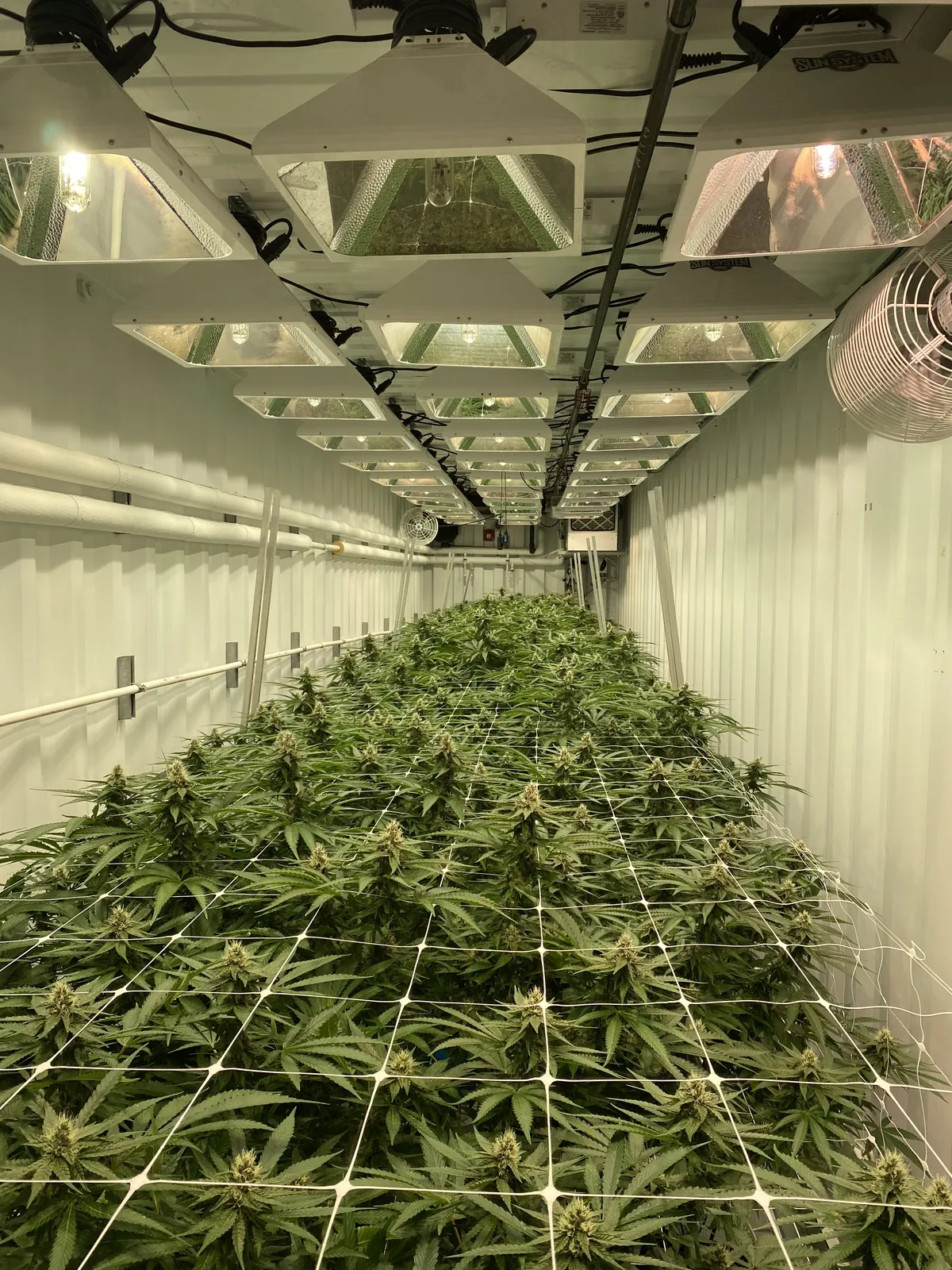
In Oregon the license is the scarce asset, not the building. A tier II indoor producer site of roughly 15,000 sq ft at $150 to $500+ per sq ft runs $2.25 million to $7.5 million or more new, but with 1,404 producers licensed in March 2023 and new producer applications closed, fitted buildings change hands with the license. Design takes 30 to 60 days and the build 3 to 6 months after permits; the OLCC change of location review runs in parallel.
Power: Oregon's average commercial electricity price was 9.80 cents per kWh in 2025 against a U.S. average of 13.37 cents, with industrial at 8.20 cents, per EIA Electric Power Annual, Table 2.10. West of the Cascades dehumidification runs most of the year; east side sites trade that for heating and humidification, so size with Urban Farms HVAC for the actual site. Siting runs through the local Land Use Compatibility Statement and the 1,000 foot school rule for retail.
Oregon specifics
Testing. Testing laboratories were the one license type exempt from the HB 4016 moratorium. Oregon Health Authority rules require retail flower to pass pesticide, water activity, potency (including delta-8 THC), mycotoxin, heavy metal and microbial tests in batches of up to 50 pounds (OAR 333-007-0320); concentrates add residual solvents unless mechanically or water extracted (333-007-0330).
Security. Every change of ownership, location or structure is a licensed event reviewed by OLCC, and the 2026 wholesale concept bars any applicant or location change before approval. Site control and a valid Land Use Compatibility Statement are gating items.
Tracking. All OLCC licensees and their employees must use the Cannabis Tracking System, which runs on Metrc software, and licensees take a Metrc CTS class.
| Topic | Oregon rule | Design response |
|---|---|---|
| Per capita caps | 1 license per 7,500 adults for production and retail, 1 per 12,500 for processing and wholesale (HB 4121) | Buy a licensed site and refit it; design around the equipment list already inside |
| Producer canopy tiers | Indoor canopy caps of 625 to 10,000 sq ft and outdoor caps of 2,500 to 40,000 sq ft across four tiers (OAR 845-025-2040) | Rooms on NextGen rolling benches sized to the acquired tier |
| Wet west side climate | No state odor rule found; the local LUCS governs siting | Dry and cure rooms held by Quest dehumidifiers sourced on request (HVAC guide) |
| Wholesale reopening | About 30 licenses; verified suitable location required at interest stage | Warehouse with vault, cold storage and Paxiom packaging line permitted before the draw |
What the same work did for an operator like you
What a Oregon applicant gets from the design desk.
- An Oregon cannabis compliance review of a license you plan to buy or a wholesale interest submission before OLCC's draw
- Cannabis facility design that refits an acquired producer, processor or retail site to its tier and rooms
- A cannabis facility design package in 30 to 60 days: room program, MEP set and equipment schedule
- Wholesale and processing layouts drawn from our cannabis extraction equipment guide
Oregon questions
Is Oregon issuing new cannabis licenses in 2026?
Not for producers, processors or retailers. OLCC's licensing page states new applications for those types and wholesalers are not being accepted. HB 4121 (2024) ties any reopening to per capita caps, and OLCC staff say wholesale, and possibly other types, fell below the cap in 2026, with about 30 wholesale licenses expected after rulemaking.
When does the Oregon cannabis license moratorium end?
It has no end date. HB 4016 (2022) paused new licenses through March 31, 2024; HB 4121 replaced the sunset with caps of one license per 7,500 adults for production and retail and one per 12,500 for processing and wholesale. OLCC checks the ratios every April.
How do I open a dispensary in Oregon?
Buy an existing retailer license and file a change of ownership or location with OLCC, which processes those continuously. The site needs a Land Use Compatibility Statement from the city or county and must sit more than 1,000 feet from a school.
How much does an OLCC license cost?
The application fee is $250, and annual license fees under OAR 845-025-1060 run from $1,000 for a micro tier I producer to $5,750 for tier II, with processors, wholesalers and retailers at $4,750. The real cost is the acquisition price of an existing license and the building that comes with it.
What is an OLCC producer license tier?
Producers hold one of four canopy tiers, micro tier I, micro tier II, tier I or tier II, each with an indoor and an outdoor limit: indoor caps of 625, 1,250, 5,000 and 10,000 sq ft and outdoor caps of 2,500, 5,000, 20,000 and 40,000 sq ft (OAR 845-025-2040). With new applications closed, the tier you operate is the tier on the license you buy. For another Western market, see Nevada cannabis licensing.
Where the Oregon rules on this page come from
- OLCC: Marijuana Licensing, new applications not accepted, change processing dates
- OLCC Bulletin CE2024-07, HB 4121 per capita thresholds and April process
- OLCC Rules Advisory Committee agenda, Sept. 25, 2026, limited lift
- OLCC Wholesale Moratorium RAC Concepts 2026, about 30 licenses, selection process
- OLCC 2023 HB 4016 Moratorium Report, history, counts, fees, LUCS
- Oregon Legislature staff measure summary, HB 4016 A (2022)
- OAR 845-025-2040, producer canopy limits, indoor and outdoor caps by tier
- OAR 845-025-1060, Fees (effective March 31, 2025), application and annual license fees by type and tier
- OLCC: Cannabis Tracking System, CTS required of all licensees and employees, Metrc software
- OHA: Cannabis Testing Quick Guide (effective March 31, 2022), required tests by product type, batch size
- EIA Electric Power Annual, Table 2.10 (2025)
Regulator: Oregon Liquor and Cannabis Commission. Last reviewed November 7, 2026.
 Record last reviewed