Rhode Island cannabis licensing, facility design and equipment.
A Rhode Island cannabis license in 2026 means one of 24 adult use retail licenses, applied for through the Cannabis Control Commission's portal by Nov. 23, 2026, or a cultivator or compassion center license bought from its holder. As of Nov. 2026 the retail window is open, the cultivator moratorium holds, and winners are drawn at random by zone.
Retail applications due Nov. 23, 2026; 24 licenses, 4 per zone across six zones, drawn at random
Syncing and validating with
Where Rhode Island is today
Rhode Island's Cannabis Control Commission (CCC) licenses adult use and medical cannabis under R.I. Gen. Laws ch. 21-28.11 and rules at 560-RICR-10-10. A federal court enjoined the first retail round April 8, 2026; H 8544, signed June 10, 2026, voided it and removed the residency requirement. The portal reopened Aug. 7, 2026 and closes Nov. 23, 2026.
Up to 24 retail licenses are available, 4 per zone across six zones: 2 general, 1 social equity, 1 workers' cooperative. A moratorium covers the 57 cultivators, so grow capacity changes hands by acquisition. Compare cannabis licensing in every state.
- May 25, 2022. The Rhode Island Cannabis Act takes effect: 24 retail licenses, 4 per zone, plus hybrid retail certificates for compassion centers.
- Dec. 29, 2025. First retail round closes with 98 applications: 56 general, 19 workers' cooperative, 23 social equity.
- April 8, 2026. A federal court enjoins the retail licensing process over the residency rule.
- June 10, 2026. H 8544 signed: prior round void, fees refunded, residency dropped, new processes due within 60 days.
- Aug. 7, 2026. Retail portal reopens; social equity certification closes Sept. 11, 2026.
- Nov. 23, 2026. Applications due. The CCC then posts qualified applicants by zone and holds a public random drawing.
How to get a Rhode Island cannabis license
- Confirm the zone and the town. Six zones are set in 21-28.11-10.3. Towns that opted out by referendum are closed, and you need a zoning official's letter confirming every final approval.
- Pick the category. General, workers' cooperative or social equity (certification closed Sept. 11, 2026). Majority Rhode Island ownership is no longer required.
- File by Nov. 23, 2026. Through the state Cannabis Licensing Portal with the $7,500 fee, waived for social equity.
- Prepare for the drawing. Applicants are posted by zone and drawn in public; your representative attends in person. Line up the $30,000 fee with cannabis business financing options.
- Pick your starting point. Dispensary plans: model the store with cannabis financial modeling. Cultivation and processing plans: price an acquisition and start new license facility planning.
What the state issues, and what each one needs built
- Cannabis retailer. 24 licenses, 4 per zone: 2 general, 1 social equity, 1 workers' cooperative. $7,500 nonrefundable application fee, $30,000 annual fee. Social equity pays no application fee and nothing in year one, then $7,500, $15,000, $22,500 and $30,000 from year five.
- Hybrid cannabis retailer. A compassion center selling adult use for $30,000 a year; 8 licensed, outside the zone cap.
- Cultivator. By facility size: Micro to 2,500 sq ft ($4,500 a year), Class A to 5,000 sq ft, Class B 5,001 to 10,000 sq ft. 57 licensed; a moratorium blocks new ones.
- Cannabis product manufacturer. $2,000 application, $4,500 a year; solvent extraction needs separate CCC pre-approval and final approval.
What a Rhode Island facility costs to design and build.
Rhode Island licenses cultivators by facility square footage, so the class sets the budget. A Class B facility at its 10,000 sq ft cap costs $1.5 million to $5 million or more at $150 to $500+ per sq ft; a 2,500 sq ft Micro runs $375,000 to $1.25 million or more. Design takes 30 to 60 days and the build 3 to 6 months after permits.
Rhode Island's average commercial electricity price was 23.40 cents per kWh in 2025 against a 13.37 cent U.S. average, per EIA Electric Power Annual, Table 2.10, so efficient lighting pays back fast. Humid coastal summers load the dehumidifiers, and Rule 2.23 makes mold control part of the odor plan. The CCC needs a zoning official's letter for the license and a second zoning letter for extraction, so lock the municipality before the design.
Rhode Island specifics
Testing. A licensed lab tests under Department of Health rules, 216-RICR-60-05-6; the seed-to-sale record must show a pass before product moves (560-RICR-10-10-2, 2.10).
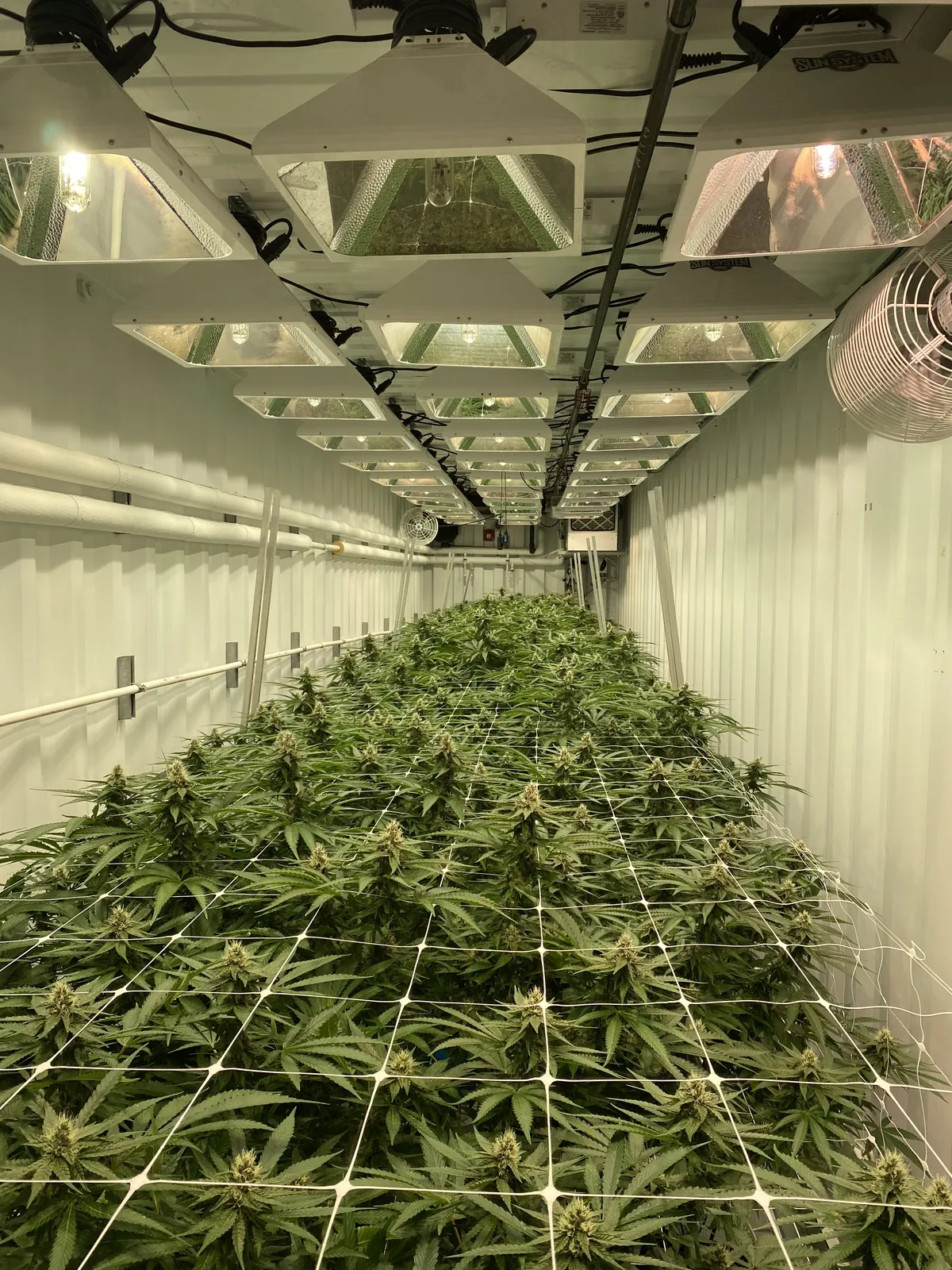
Odor. Rule 2.23 requires filtration that keeps odor from significantly altering the air outside, controls mold and follows an approved odor plan (2.14).
Security and tracking. Commercial grade alarm inspected every 30 days, cameras recording 24 hours a day, footage kept 60 days (2.13). All reporting runs in Metrc (2.9).
Packaging and edibles. 10 mg THC per serving, 100 mg per package, 500 mg for tinctures. Child-resistant, tamper evident, 1 inch universal symbol, bold warnings in a yellow box (2.6, 2.7).
| Topic | Rhode Island rule | Design response |
|---|---|---|
| Extraction | Closed loop; butane, propane, ethanol or preapproved hydrocarbon at 99.0% purity; engineer stamped plans for pre-approval, Fire Marshal letter for final approval (2.20) | Hazardous location room in the stamped MEP set (C1D1 room requirements); used Precision Extraction systems |
| Odor and mold | Filtration must keep odor from altering outside air and address mold (2.23) | Negative pressure and carbon scrubbing; Anden dehumidifiers sized to the transpiration load; Breeza fans at canopy |
| Cultivation classes | Micro to 2,500 sq ft, Class A to 5,000, Class B to 10,000 sq ft of facility; moratorium | Rooms planned to the class cap so an acquired license is fully used (grow room layout and airflow) |
| Edibles and packaging | 10 mg per serving, 100 mg per package; child-resistant, tamper evident (2.6, 2.7) | Dosing line built to the caps (edibles equipment) with Paxiom weigh and fill |
What the same work did for an operator like you
What a Rhode Island applicant gets from the design desk.
- A Rhode Island cannabis compliance review against 560-RICR-10-10-2 before the Nov. 23, 2026 filing or an acquisition
- Cannabis facility design for a Micro, Class A or Class B facility, planned to the cap
- A cannabis facility design package in 30 to 60 days with the stamped MEP set extraction pre-approval requires
- HVAC sized for coastal New England from our cannabis HVAC design guide
Rhode Island questions
How do I open a dispensary in Rhode Island?
Apply to the Cannabis Control Commission for one of 24 adult use retail licenses by Nov. 23, 2026. You need a site in one of six zones with a zoning official's letter, the $7,500 application fee and the $30,000 annual fee before issuance. Winners are drawn at random by zone, so completeness wins.
How does the Rhode Island cannabis retail lottery work?
Under 560-RICR-10-10-1, the CCC posts qualified applicants by zone and holds a public drawing on an announced date. Your representative must attend in person. A name drawn in two zones keeps one. Each zone yields 2 general, 1 social equity and 1 workers' cooperative license.
Can I get a Rhode Island cultivator license?
Not by application. A moratorium on new cultivator licenses is in effect, and the only window ever held closed in April 2017. The route is buying one of the 57 licensed cultivators and retrofitting to the Micro, Class A or Class B cap. For an open cultivation market, compare New York.
What changed in Rhode Island cannabis licensing in 2026?
A federal court enjoined the retail process on April 8, 2026 over the residency requirement. H 8544, signed June 10, 2026, voided the first round, refunded fees, removed the residency rule and rewrote social equity criteria. The portal reopened Aug. 7, 2026 with a Nov. 23, 2026 deadline.
What does a Rhode Island extraction room need?
A closed-loop system running butane, propane, ethanol or a preapproved hydrocarbon at 99.0% purity, in a room built from plans stamped by a Rhode Island professional engineer. The CCC issues a pre-approval letter, then final approval after a State Fire Marshal inspection. Start with our extraction equipment guide.
Where the Rhode Island rules on this page come from
- R.I. Gen. Laws 21-28.11-10.3, the six zones
- 2026 H 8544, 24 licenses and 4 per zone (21-28.11-10.2), voided round, refunds, social equity criteria
- 560-RICR-10-10-1, fees, random selection, zoning letter, referendum towns, cultivator classes
- 560-RICR-10-10-2, extraction approvals, odor, security, packaging and edibles
- CCC Adult Use Retail Update, March 13, 2026, 97 applications, 57 cultivators, 8 compassion centers, moratorium
- CCC testimony on H 8544, May 21, 2026, April 8, 2026 injunction, residency change
- CCC Cultivation Moratorium Report, April 2024, class sizes, 2017 window, Metrc
- EIA Electric Power Annual, Table 2.10 (2025), commercial electricity price
Regulator: Rhode Island Cannabis Control Commission. Last reviewed November 7, 2026.
 Record last reviewed