Washington cannabis licensing, facility design and equipment.
A Washington cannabis license is rarely new: the Liquor and Cannabis Board accepts no producer, processor or retailer applications outside the Social Equity Program, whose window closed July 1, 2025. As of Nov. 2026 entry is by acquisition or social equity selection, annual fees rose to $1,781 on July 1, 2026, and producers hold Tier 1 to 3 canopy.
LCB license freeze continues; social equity window closed July 1, 2025; annual fees $1,781 from July 1, 2026
Syncing and validating with
Where Washington is today
The Washington State Liquor and Cannabis Board (LCB) licenses producers, processors and retailers under RCW 69.50 and WAC 314-55, and it is not accepting new applications for any of the three except through the Social Equity Program. The producer window is closed by rule and retail is capped by county, so new entry means buying a license or qualifying for social equity.
RCW 69.50.335 lets the LCB issue up to 52 social equity retail licenses from Jan. 1, 2024, up to 100 processor licenses and, from Jan. 1, 2025, up to 10 producer licenses, with fees waived through July 1, 2032. The 2025 registration window closed July 1, 2025. Compare cannabis licensing in every state.
- 2020. E2SHB 2870 creates the Social Equity Program for forfeited and unissued retail licenses.
- 2023. SB 5080 adds up to 52 social equity retail, 100 processor and 10 producer licenses, sited in any jurisdiction that allows the activity.
- Jan. 18, 2025. Rules for the next social equity round take effect (WAC 314-55-570).
- July 1, 2025. The 30 day social equity registration window closes; applicants are rubric scored.
- July 1, 2026. Annual producer, processor and retailer fees rise from $1,381 to $1,781 under EHB 2681 (WSR 26-14-119).
- July 1, 2032. Social equity retail reissuance and the fee waivers under RCW 69.50.335 end.
How to get a Washington cannabis license
- Accept the freeze. No new producer, processor or retailer applications are taken outside social equity, so budget for an acquisition. Price it with cannabis financial modeling.
- Check social equity eligibility. Two of four: five years in a disproportionately impacted area between 1980 and 2010, a cannabis arrest or conviction for yourself or a family member, income below the state median, or disadvantaged status under chapter 39.19 RCW.
- Pick the jurisdiction. Retail is capped per county with local approval; a social equity license may sit anywhere that allows the activity, but once licensed it cannot move to a different city, town or county (RCW 69.50.335). From Jan. 1, 2026, HB 2870 retail licensees without a secured location may move to another county if their score exceeds the lowest successful score there.
- Match the tier to the canopy. Tier 2 tops out at 10,000 sq ft and Tier 3 at 30,000, and the LCB can cut canopy if statewide production exceeds the maximum. Plan rooms to the grow room equipment list before you buy.
- Pick your starting point. Dispensary plans: cannabis compliance consulting on the county cap. Cultivation and processing plans: new license facility planning for the acquired site.
What the state issues, and what each one needs built
- Cannabis producer. Tier 1 under 4,000 sq ft of plant canopy, Tier 2 4,000 to 10,000 sq ft, Tier 3 10,000 to 30,000 sq ft (WAC 314-55-075). $250 application, $1,781 a year; window closed.
- Cannabis processor. $250 application, $1,781 a year (WAC 314-55-077). Producers and processors may not apply for retail licenses (RCW 69.50.328).
- Cannabis retailer. Capped per county by the board, five licenses per entity, $250 application, $1,781 a year (WAC 314-55-079).
- Social equity licenses. Up to 52 retail, 100 processor and 10 producer licenses to businesses at least 51% owned by people meeting two of four criteria; annual fees waived through July 1, 2032. Issued so far: 16 across fiscal 2024 to 2027 per the LCB table.
What a Washington facility costs to design and build.
Washington licenses are cheap to hold and costly to acquire, so the budget is building plus purchase. A Tier 3 producer at 30,000 sq ft of canopy sits inside a larger building; an example 45,000 sq ft building runs $6.75 million to $22.5 million or more at $150 to $500+ per sq ft; a Tier 2 at 10,000 sq ft in about 16,000 sq ft runs $2.4 million to $8 million. Design takes 30 to 60 days and the build 3 to 6 months after permits.
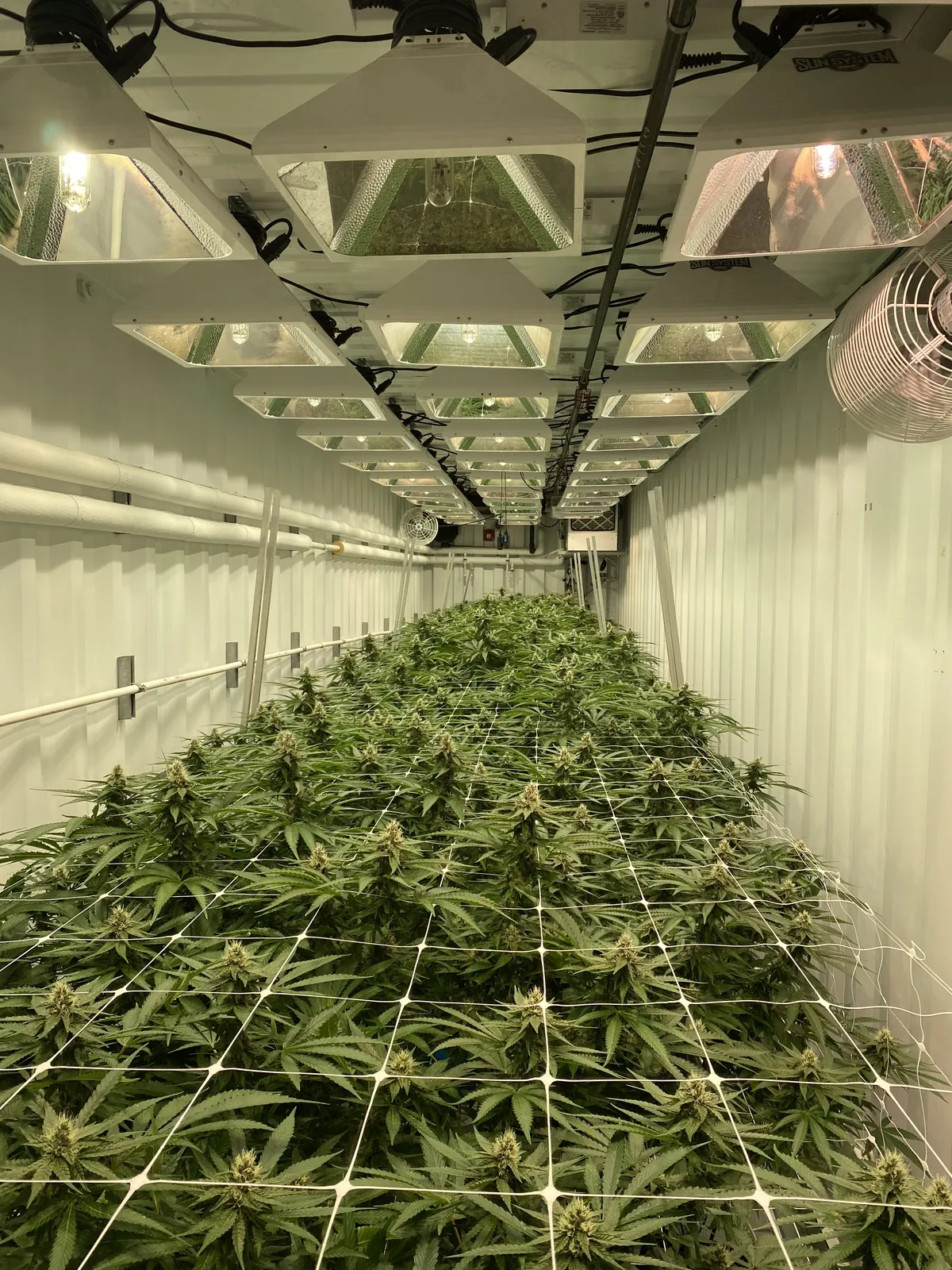
Washington's average commercial electricity price was 10.97 cents per kWh in 2025 against a 13.37 cent U.S. average, per EIA Electric Power Annual, Table 2.10. West of the Cascades dehumidification runs most of the year; east of them summer cooling and winter humidification lead. Retail sits under county caps, and a social equity license can be placed in any willing jurisdiction but cannot move to a different city, town or county once licensed, so the first jurisdiction is permanent.
Washington specifics
Testing. Producers must make quality assurance results available to every purchasing processor and label each lot with lot number, UBI and weight (WAC 314-55-075). Under WAC 314-55-102, flower is tested for potency, water activity (fail above 0.65 aw), foreign matter, microbials, mycotoxins and pesticides; solvent concentrates for potency, mycotoxins, residual solvents and pesticides. Heavy metals are required for DOH compliant product.
Security and tracking. Every licensee reports inventory and sales in the Cannabis Central Reporting System (CCRS). Retail product stays behind a counter or barrier (WAC 314-55-079). WAC 314-55-083 requires alarms on every perimeter entry point and window, and cameras of at least 640 x 470 resolution on every area where cannabis is grown, processed, stored or sold, with recordings kept 45 days.
Packaging and edibles. Internet sales and delivery are prohibited (WAC 314-55-079). Edibles cap at 10 mg delta-9 THC per serving and 100 mg per package, and a concentrate unit at 1 gram (WAC 314-55-095).
| Topic | Washington rule | Design response |
|---|---|---|
| Producer tiers | Tier 1 under 4,000 sq ft, Tier 2 to 10,000, Tier 3 to 30,000 sq ft of canopy; LCB may cut canopy statewide | Rooms planned to the tier line (grow room layout and airflow), Gavita lighting sourced on request |
| Wet west, dry east | No statewide odor rule; local code governs | Anden dehumidifiers for Puget Sound sites, MicroCool humidification east of the Cascades |
| Extraction | Hydrocarbon (butane, isobutane, propane, heptane) and CO2 at 99% purity in a closed loop; ethanol recaptured, never vented; a licensed engineer certifies each system and the local fire official approves it (WAC 314-55-104) | Hazardous location room from C1D1 room requirements, used Precision Extraction systems |
| Retail | County cap, five licenses per entity, product behind a counter, no delivery | Vault and intake sized to CCRS reporting (processing facility layout) |
What the same work did for an operator like you
What a Washington applicant gets from the design desk.
- A Washington cannabis compliance review against WAC 314-55 before you close on a license
- Cannabis facility design for a Tier 2 or Tier 3 producer retrofit, planned to the canopy line
- A cannabis facility design package in 30 to 60 days for a processor suite with extraction
- Dehumidification and HVAC for a maritime or high desert site from our cannabis HVAC design guide
Washington questions
How do I open a dispensary in Washington state?
Buy an existing retail license or qualify for the Social Equity Program. The LCB is not accepting new retailer applications, retail is capped per county, each entity may hold five, and local approval is required. The license costs $250 to apply and $1,781 a year; the purchase price and the county cap are the real constraints.
Is the LCB issuing new producer licenses?
No. WAC 314-55-075 says the producer application window is closed, and the LCB may reopen it when it chooses. The only exception is up to 10 social equity producer licenses from Jan. 1, 2025, each paired with a processor license. Otherwise, acquire a license and retrofit.
How does the Washington social equity cannabis license work?
RCW 69.50.335 allows up to 52 retail, 100 processor and 10 producer licenses for businesses at least 51% owned by people meeting two of four criteria, with annual fees waived through July 1, 2032. The 2025 window closed July 1, 2025; applicants are rubric scored, and the LCB lists 16 licenses issued.
What are Washington producer tiers?
Tier 1 is under 4,000 sq ft of plant canopy, Tier 2 is 4,000 to 10,000 sq ft and Tier 3 is 10,000 to 30,000 sq ft. The LCB can reduce canopy if statewide production exceeds the maximum, so design rooms that still pencil smaller. Compare an open producer market at Nevada.
What did Washington change for cannabis licenses in 2026?
EHB 2681 (chapter 192, Laws of 2026) raised annual producer, processor and retailer fees from $1,381 to $1,781, and the LCB adopted the matching rule change effective July 1, 2026. Application fees stay at $250 and producer tiers are unchanged. The freeze on new applications outside social equity continues.
Where the Washington rules on this page come from
- LCB: Cannabis Licensing, application freeze, HB 2681 fee increase, CCRS
- RCW 69.50.335, social equity license counts, siting, fee waivers, July 1, 2032 sunset
- LCB: Cannabis Social Equity, eligibility criteria and licenses issued by fiscal year
- LCB: Social Equity FAQ, July 1, 2025 window close, WAC 314-55-570, mobility rules
- WAC 314-55-075, producer tiers, closed application window, lot labels
- WAC 314-55-079, retail county caps, five per entity, fees, counter rule
- WSR 26-14-119, July 1, 2026 fee rule aligning with EHB 2681
- WAC 314-55-083, perimeter alarms, camera resolution and coverage, 45 day retention
- WAC 314-55-095, serving, package and transaction limits
- WAC 314-55-102, quality assurance test panel and action levels
- WAC 314-55-104, extraction solvents, closed loop systems, engineer certification, fire approval
- EIA Electric Power Annual, Table 2.10 (2025), commercial electricity price
Regulator: Washington State Liquor and Cannabis Board. Last reviewed November 7, 2026.
 Record last reviewed